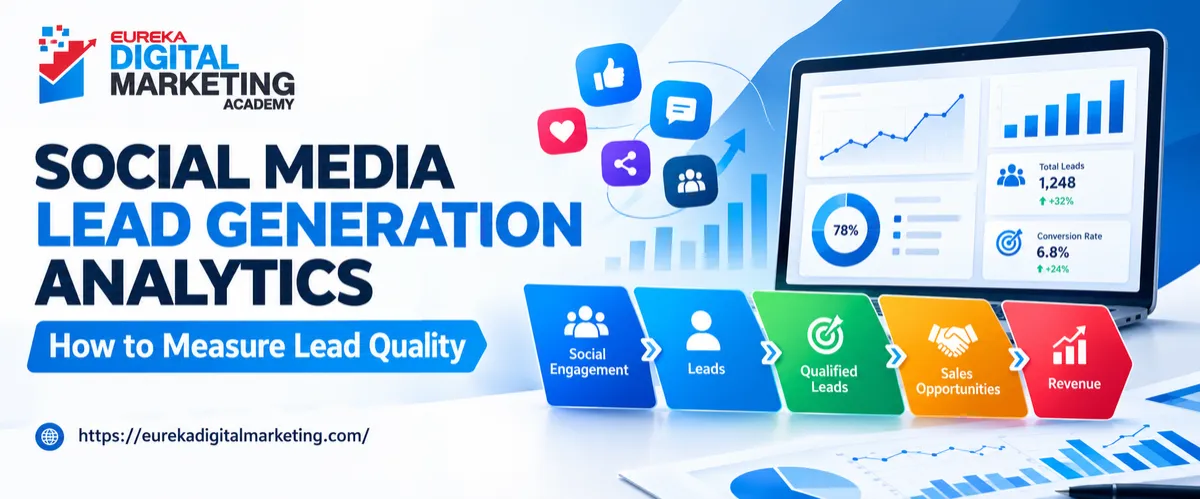
Social Media Lead Generation Analytics: How to Measure Lead Quality
Social media can generate awareness, engagement, website traffic, and leads, but not every lead has the same business value. A campaign may produce hundreds of form submissions while generating only a small number of prospects who are genuinely interested in buying.
This is why social media lead generation analytics should go beyond likes, comments, reach, and clicks. Businesses need to understand where leads come from, whether those leads are qualified, how they move through the sales funnel, and which campaigns ultimately contribute to revenue.
In this guide, we will explain how to measure social media lead quality, which lead quality metrics matter, how to use lead scoring, and how to connect social media performance with conversions and business outcomes.
What Is Social Media Lead Generation Analytics?
Social media lead generation analytics is the process of collecting and analyzing data from social media campaigns to understand how effectively they generate qualified prospects.
It combines social media marketing analytics, lead tracking, conversion data, CRM information, and campaign performance data.
Instead of measuring only:
Likes
Comments
Shares
Followers
Reach
Impressions
you also measure:
Leads generated
Qualified leads
Marketing qualified leads
Sales qualified leads
Lead conversion rate
Cost per lead
Cost per qualified lead
Lead-to-customer conversion rate
Customer acquisition cost
Revenue generated
Return on investment
For a broader introduction to social media measurement, see our guide on how social media analytics works.
Why Measuring Lead Quality Matters
Generating more leads does not necessarily mean generating better results.
Imagine two campaigns:
Campaign A generates 300 leads, but only 10 become qualified prospects.
Campaign B generates 100 leads, but 25 become qualified prospects.
Looking only at lead volume would make Campaign A appear stronger. However, lead quality analysis can reveal that Campaign B is producing a larger proportion of valuable prospects.
This is why marketers should evaluate the complete journey:
Social Media → Click → Landing Page → Lead → Qualified Lead → Sales Opportunity → Customer → Revenue
Understanding this journey allows businesses to identify which campaigns attract people with genuine buyer intent rather than simply generating low-quality form submissions.
What Is Lead Quality?
Lead quality refers to how closely a lead matches the characteristics of a potential customer and how likely that person is to move toward a purchase.
A high-quality lead may:
Match your target audience
Have a genuine need for your product or service
Have purchasing intent
Meet your location or industry requirements
Have an appropriate budget
Engage with your sales team
Move further through the sales pipeline
A low-quality lead may submit a form but have little interest in purchasing.
This distinction makes lead qualification an important part of social media performance measurement.
Social Media Lead Quality vs Lead Quantity
Lead quantity tells you how many leads your campaigns generated.
Lead quality tells you how valuable those leads are.
Important measurements include:
MetricWhat It Tells YouLeads generatedTotal number of leadsQualified leadsLeads that meet your criteriaLead quality scoreRelative quality of individual leadsConversion ratePercentage that complete the desired actionCost per leadCost of acquiring each leadCost per qualified leadCost of acquiring a qualified prospectLead-to-customer ratePercentage of leads becoming customersCustomer acquisition costCost of acquiring customersRevenue attributionRevenue associated with campaigns
A strong social media lead tracking system should therefore connect campaign activity with downstream business results.
Key Social Media Lead Generation Metrics to Track
1. Lead Volume
The first metric is the total number of leads generated by each campaign, platform, audience, or content format.
Lead volume can help you understand campaign reach and acquisition capacity, but it should not be analyzed alone.
A campaign producing 500 leads may appear successful until you discover that only 5 are qualified.
2. Lead Quality Score
A lead quality score helps businesses assign value to leads based on characteristics and behavior.
You might score leads according to:
Job role
Industry
Location
Company size
Budget
Service interest
Website behavior
Content engagement
Purchase intent
Sales interactions
For example, someone who downloads a general guide may receive a lower score than someone who requests a pricing consultation.
Lead scoring can help sales teams prioritize prospects with stronger potential.
3. Marketing Qualified Leads
Marketing qualified leads (MQLs) are prospects who meet predefined marketing criteria indicating that they may be ready for further nurturing or sales evaluation.
A business might classify someone as an MQL when they:
Complete a lead form
Download high-intent content
Visit important product pages
Engage with multiple campaigns
Request additional information
The exact definition should be established between marketing and sales teams.
4. Sales Qualified Leads
Sales qualified leads (SQLs) have progressed further and are considered suitable for direct sales engagement.
Tracking MQL-to-SQL progression helps determine whether social media campaigns are generating leads that actually have commercial potential.
For example:
1,000 Social Leads → 250 MQLs → 80 SQLs → 20 Customers
This gives you much more information than simply reporting that the campaign generated 1,000 leads.
5. Lead Conversion Rate
The social media conversion rate measures the percentage of users who complete a desired action after interacting with your social media campaign.
Depending on your objective, the conversion may be:
Form submission
Consultation request
Phone call
Purchase
Registration
Download
Demo request
Conversion rate helps connect social media activity with measurable actions.
For additional conversion optimization insights, see our guide on Conversion Rate Optimization (CRO), which explains how landing pages, forms, CTAs, and other elements influence conversions.
6. Cost Per Lead
Cost per lead (CPL) tells you how much your campaign spends to generate one lead.
The basic calculation is:
Cost Per Lead = Total Campaign Spend ÷ Total Leads
For example, if a campaign spends $1,000 and generates 100 leads:
$1,000 ÷ 100 = $10 CPL
However, a low CPL does not automatically indicate good performance.
If those 100 leads are poorly qualified, the campaign may still be inefficient.
7. Cost Per Qualified Lead
This is often more useful than basic CPL when measuring lead quality.
Cost Per Qualified Lead = Total Campaign Spend ÷ Qualified Leads
Suppose:
Campaign A spends $1,000 and generates 200 leads
Only 20 are qualified
Its cost per qualified lead is:
$1,000 ÷ 20 = $50
Another campaign may generate fewer total leads but more qualified prospects.
This metric helps marketers compare campaigns based on quality rather than volume.
8. Lead-to-Customer Conversion Rate
The lead-to-customer conversion rate measures how many leads eventually become customers.
Formula:
Lead-to-Customer Rate = Customers ÷ Total Leads × 100
For example:
100 leads → 10 customers
10 ÷ 100 × 100 = 10%
This metric provides a stronger connection between lead generation and actual business results.
9. Customer Acquisition Cost
Customer acquisition cost (CAC) measures the total cost associated with acquiring customers.
Depending on the reporting model, CAC may include:
Advertising spend
Marketing costs
Sales costs
Software
Agency fees
Other acquisition expenses
Comparing CAC across campaigns can help identify which channels produce customers more efficiently.
10. Return on Ad Spend
ROAS, or return on ad spend, compares advertising revenue with advertising expenditure.
Formula:
ROAS = Revenue From Ads ÷ Advertising Spend
For example, if an advertising campaign generates $5,000 in attributed revenue from $1,000 of advertising spend:
$5,000 ÷ $1,000 = 5X ROAS
For paid social campaigns, ROAS can be combined with lead quality and customer conversion data to understand whether campaigns are producing profitable outcomes.
You can also explore how to improve ROAS in Meta Ads for additional campaign optimization strategies.
How to Measure Lead Quality From Social Media
Step 1: Define Your Ideal Lead
Before measuring lead quality, establish what a qualified lead means for your business.
Define characteristics such as:
Target industry
Geographic location
Business size
Budget
Service requirement
Job role
Purchase intent
Without a clear definition, it becomes difficult to determine whether your social media campaigns are attracting the right audience.
Step 2: Track Lead Sources
Use social media lead tracking to identify where every lead originated.
Track:
Platform
Campaign
Ad
Audience
Creative
Landing page
Form
Date
Lead status
This allows you to compare different sources and identify which campaigns produce better-quality prospects.
Step 3: Connect Social Media With CRM Data
Social media data becomes much more valuable when connected with CRM data.
A CRM can help you track the journey from:
Lead → MQL → SQL → Opportunity → Customer
This makes it possible to identify which social media campaigns are generating customers rather than simply form submissions.
CRM integration can also support:
Lead scoring
Lead nurturing
Sales follow-up
Customer segmentation
Pipeline tracking
Revenue attribution
Step 4: Use Lead Scoring
Create a simple scoring model based on demographic and behavioral information.
For example:
Lead ActivityExample ScoreSocial media form submission+5Website pricing page visit+10Case study download+10Demo request+25Consultation request+30Matches target industry+15
These values are examples only. Your scoring system should reflect your actual customer journey.
Social Media Attribution: Which Campaign Generated the Lead?
Social media attribution helps marketers understand how different touchpoints contributed to a conversion.
A prospect might:
See an Instagram advertisement.
Visit the website.
Read a blog.
Return through a retargeting campaign.
Submit a form.
Become a customer later.
If you only measure the final conversion source, you may overlook earlier interactions.
This is why conversion attribution and campaign attribution can provide a broader view of the customer journey.
How to Track Lead Quality Across Social Media Platforms
Different platforms can produce different types of leads.
For example, compare:
Track:
Leads
CPL
Qualified leads
Cost per qualified lead
Conversion rate
Customer acquisition cost
Track:
Profile visits
Link clicks
Leads
Engagement
Conversion rate
Qualified leads
For B2B campaigns, track:
Job roles
Company size
Lead quality
MQLs
SQLs
Opportunity rate
Customer conversion
TikTok
Track:
Video engagement
Clicks
Landing page visits
Leads
Lead quality
Conversion rate
The goal is not necessarily to identify which platform generates the most leads. Instead, determine which platforms generate the most valuable leads relative to cost.
Our Ultimate Guide to Social Media Marketing can provide broader context on social media strategy and campaign management.
Measure Lead Quality Through the Sales Funnel
A useful social media funnel analytics framework looks at every stage:
Stage 1: Awareness
Track:
Reach
Impressions
Video views
Engagement
Stage 2: Consideration
Track:
Website visits
Landing page visits
Content engagement
Click-through rate
Stage 3: Lead Generation
Track:
Form submissions
Calls
Signups
Consultation requests
Stage 4: Lead Qualification
Track:
MQLs
SQLs
Lead quality score
Sales acceptance rate
Stage 5: Conversion
Track:
Opportunities
Customers
Revenue
Customer acquisition cost
ROAS
This approach gives marketers a complete view of social media performance metrics rather than focusing on surface-level engagement.
How Landing Pages Affect Social Media Lead Quality
Your social media campaign is only one part of the conversion process.
A strong campaign can still produce poor results if the landing page has:
Unclear messaging
Weak CTAs
Complicated forms
Poor mobile experience
Slow loading
Weak trust signals
Irrelevant offers
This is why landing page performance should be included in your lead generation analytics.
For example:
Ad → Landing Page → Form → CRM → Sales
If leads are dropping between the landing page and form, the problem may not be the social campaign itself.
Use Conversion Tracking to Measure Campaign Performance
Social media conversion tracking allows marketers to connect campaigns with actions taken on a website.
Track important events such as:
Lead form submissions
Purchases
Phone calls
Demo requests
Bookings
Downloads
Signups
Conversion tracking is especially important when comparing paid and organic campaigns.
Our guide on how conversion tracking for digital campaigns improves marketing ROI is another relevant resource for understanding campaign measurement.
How to Improve Social Media Lead Quality
Once you have enough data, use it to optimize campaigns.
Improve Audience Targeting
Focus on audiences that consistently generate qualified leads rather than simply producing high engagement.
Refine Your Offer
Make sure the offer matches the audience's needs and purchase intent.
Improve Lead Forms
Ask enough questions to qualify prospects without creating unnecessary friction.
Improve Landing Pages
Make the landing page message consistent with the social media advertisement.
Retarget High-Intent Users
Use remarketing to reconnect with users who have already demonstrated interest.
Relevant remarketing data can include conversion tracking, audience behavior, campaign performance, and conversion rate.
Analyze Campaign-Level Data
Compare campaigns based on:
Qualified Leads → Customers → Revenue
rather than only:
Clicks → Leads
Common Mistakes When Measuring Social Media Leads
Focusing Only on Lead Volume
More leads do not always mean better performance.
Measuring Engagement Without Conversions
Likes and comments can be useful indicators, but they do not necessarily represent revenue-generating activity.
Ignoring Lead Quality
A campaign with a high CPL may actually produce better customers than one with a very low CPL.
Not Connecting Marketing and Sales Data
Without CRM and sales information, marketers may not know what happens after the form submission.
Using Only Last-Click Attribution
A customer's journey can involve multiple social and non-social touchpoints.
Ignoring Customer Acquisition Cost
A campaign may generate leads at a low cost but still be expensive when the final customer acquisition cost is considered.
A Simple Social Media Lead Quality Dashboard
A practical dashboard can include:
CategoryMetricsReachImpressions, reach, frequencyEngagementEngagement rate, comments, sharesTrafficClicks, CTR, landing page visitsLeadsLeads, CPLQualityLead score, qualified leads, MQLs, SQLsSalesOpportunities, customersCostCPQL, CACRevenueRevenue, ROAS, ROI
This gives marketing teams a clearer picture of social media lead generation performance.
How to Turn Analytics Into Actionable Insights
Analytics only becomes useful when it leads to better decisions.
For example:
Finding: Instagram generates many leads but few qualified prospects.
Possible action: Review audience targeting and lead qualification criteria.
Finding: LinkedIn generates fewer leads but a higher MQL-to-customer rate.
Possible action: Evaluate whether more budget should be allocated to the higher-quality audience.
Finding: A campaign generates strong clicks but weak conversions.
Possible action: Review the landing page, offer, CTA, and conversion process.
This is the difference between simply reporting data and using data-driven marketing to improve performance.
Frequently Asked Questions
What is social media lead generation analytics?
It is the process of measuring social media campaigns to understand lead volume, lead quality, conversions, customer acquisition, and revenue.
What is the most important metric for measuring lead quality?
There is no single universal metric. Businesses should consider qualified leads, lead quality scores, MQLs, SQLs, conversion rates, customer acquisition cost, and revenue together.
How do you measure social media lead quality?
Define qualified-lead criteria, track lead sources, use lead scoring, connect social campaigns with CRM data, and monitor the journey from lead to customer.
What is a good lead conversion rate?
There is no universal benchmark because conversion rates vary by industry, offer, audience, platform, funnel, and campaign objective. Compare performance against your own historical data and business goals.
Why is cost per qualified lead important?
It shows how much you spend to generate a lead that actually meets your qualification criteria, making it more informative than basic CPL when lead quality varies.
How can CRM data improve social media analytics?
CRM data can connect social media leads with qualification, sales opportunities, customers, and revenue, allowing marketers to measure downstream campaign performance.
Final Thoughts
Effective social media lead generation analytics is about measuring more than the number of leads a campaign generates.
The real question is:
Are your social media campaigns generating qualified prospects who become customers and contribute to revenue?
To answer that question, track lead quality metrics, lead scoring, MQLs, SQLs, conversion rates, cost per qualified lead, customer acquisition cost, attribution, and revenue.
Start by defining what a qualified lead means for your business. Then connect social media platforms with conversion tracking and CRM data, analyze the complete customer journey, and use the insights to improve targeting, creative, landing pages, and lead nurturing.
When social media analytics moves from engagement measurement to lead quality and revenue measurement, marketers can make more informed decisions about campaign optimization, budget allocation, and customer acquisition.