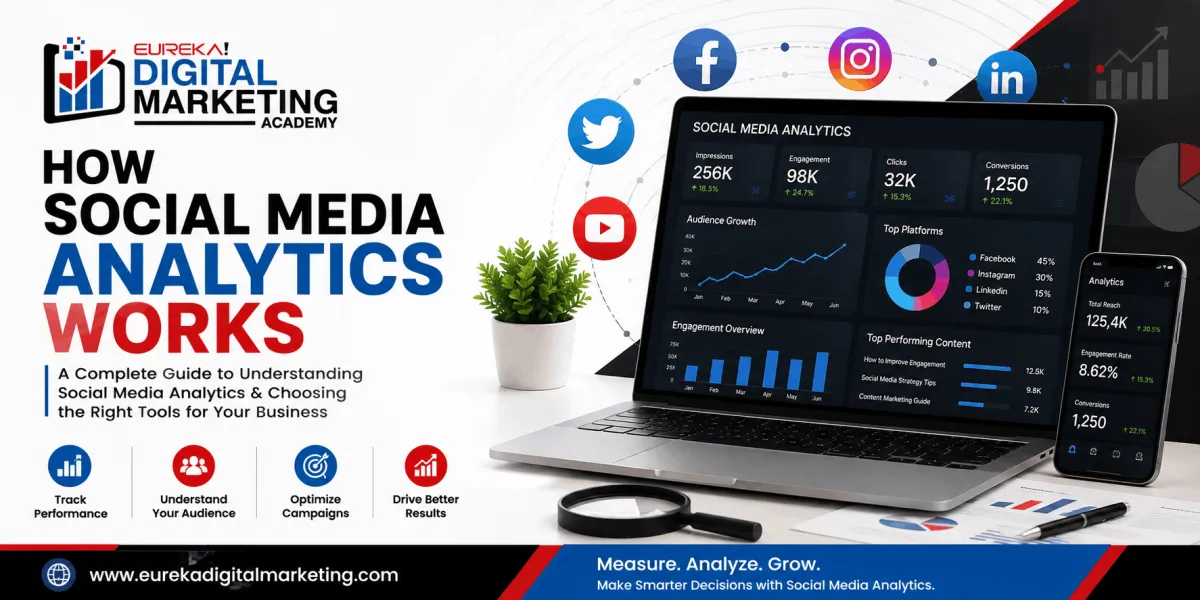
How Social Media Analytics Works: A Guide to Choosing the Right Analytics Tools for Your Business
Social media has become an important part of digital marketing, but simply posting content and gaining followers does not guarantee business growth. To understand whether your social media efforts are actually delivering results, you need reliable data and performance insights.
This is where understanding How Social Media Analytics Works becomes important. Social media analytics helps businesses collect, organize, and interpret data from their social platforms so they can understand audience behavior, evaluate content performance, and make better marketing decisions.
With the right social media analytics tools, businesses can go beyond likes and followers to measure engagement, reach, website traffic, leads, conversions, and overall campaign performance.
What Is Social Media Analytics?
Social media analytics is the process of collecting and analyzing data from social media platforms to evaluate marketing performance and audience behavior.
When businesses learn How Social Media Analytics Works, they can identify which content performs well, which audiences engage with their brand, and which platforms contribute most to their marketing objectives.
Common data points include:
Likes and reactions
Comments
Shares
Saves
Follower growth
Post reach
Impressions
Engagement rate
Website clicks
Leads and conversions
Audience demographics
The goal is not simply to collect data. The real value comes from turning that data into actionable insights.
How Social Media Analytics Works
The process usually involves four main stages: collecting data, organizing information, analyzing performance, and using insights to improve future campaigns.
1. Data Collection
Social media platforms generate large amounts of information whenever users interact with content. Analytics systems collect information about posts, audiences, campaigns, engagement, and traffic.
Depending on the platform, businesses can access data about:
Content reach
Audience activity
Engagement
Profile visits
Link clicks
Video views
Ad performance
Modern social media analytics software can bring data from multiple platforms into one dashboard, making it easier to monitor performance.
2. Data Organization
Raw data can be difficult to understand when it is spread across different social networks.
Analytics platforms organize information into reports and dashboards so marketers can compare results more efficiently.
For example, a business may compare Facebook, Instagram, LinkedIn, and other platforms to determine where its audience is most active.
3. Performance Analysis
Once data is organized, marketers can identify trends and patterns.
This is where social media performance analytics becomes particularly valuable. Instead of looking at individual posts, marketers can analyze performance over weeks or months.
They can identify:
Best-performing content
Highest-engagement topics
Most active audience segments
Strongest social platforms
Successful posting times
Campaign trends
4. Marketing Optimization
The final step is using insights to improve future marketing activities.
For example, if analytics show that educational videos consistently generate more engagement than promotional posts, a business can create more educational video content.
This turns analytics into a continuous improvement process.
Why Businesses Need Social Media Analytics
Without analytics, social media marketing can become based on assumptions.
A business may believe that a particular platform is performing well simply because it has many followers. However, another platform with a smaller audience may actually generate more website visits, leads, or sales.
Using social media marketing analytics helps businesses understand the difference between surface-level engagement and meaningful business results.
Analytics can help you:
Measure campaign performance
Understand your audience
Identify successful content
Track engagement
Monitor competitor activity
Improve advertising performance
Measure website traffic from social media
Support better marketing decisions
Key Metrics to Track
Understanding How Social Media Analytics Works also requires knowing which metrics actually matter.
Engagement Rate
Engagement rate measures how actively users interact with your content.
It can include likes, comments, shares, saves, and other interactions.
A high engagement rate can indicate that your content is relevant to your audience.
Reach and Impressions
Reach measures how many unique users saw your content, while impressions represent the number of times content was displayed.
These metrics help businesses understand content visibility.
Follower Growth
Follower growth can provide an indication of whether your audience is expanding, but it should not be treated as the only measure of success.
A smaller but highly engaged audience can be more valuable than a large inactive audience.
Click-Through Rate
Click-through rate helps businesses understand how effectively social content encourages users to visit a website or landing page.
Conversions
Conversions are often more valuable than engagement metrics because they connect social media activity with business outcomes.
Depending on your business, a conversion could be:
A purchase
A lead submission
A consultation booking
A signup
A download
Choosing the Right Social Media Analytics Tools
There are many social media analytics tools available, ranging from basic platform dashboards to advanced analytics platforms.
The right choice depends on your business size, marketing goals, number of social accounts, and reporting requirements.
Before selecting a tool, consider the following factors.
Multi-Platform Reporting
If your business uses multiple social networks, look for a solution that can combine data into centralized reports.
This saves time and makes cross-platform comparison easier.
Easy-to-Understand Dashboards
A good analytics platform should present complex data in a way that marketers can understand quickly.
Look for dashboards that provide clear charts, performance summaries, and customizable reports.
Reporting Features
Businesses often need to share marketing results with managers, clients, or stakeholders.
Social media reporting tools can help create scheduled or customized reports that highlight important metrics.
Campaign Tracking
If you regularly run paid or organic campaigns, choose a solution that allows you to monitor campaign-level performance.
This can help you determine which campaigns are generating the strongest results.
Integration Capabilities
Your analytics solution may need to connect with advertising platforms, websites, CRM systems, or other marketing tools.
Strong integrations can provide a more complete view of your customer journey.
Social Media Analytics Software vs. Native Platform Insights
Most social media platforms provide their own analytics dashboards. These native tools can be useful for basic reporting.
However, dedicated social media analytics software can provide additional capabilities such as:
Cross-platform reporting
Historical data analysis
Automated reports
Advanced audience insights
Competitor monitoring
Campaign comparisons
Custom dashboards
For businesses managing several platforms or multiple campaigns, a dedicated solution may make reporting more efficient.
Social Media Monitoring Tools and Analytics
Analytics and monitoring are closely related but serve slightly different purposes.
Social media monitoring tools can help businesses track brand mentions, conversations, keywords, and audience sentiment across social networks.
For example, a company launching a new product may monitor conversations to understand how customers are reacting to the launch.
Combining monitoring with analytics can give marketers a broader understanding of both performance and audience perception.
How Social Media Analytics Improves Marketing Performance
Analytics should not simply be used for monthly reporting. Businesses can use the data to continuously improve their social media strategy.
Improve Content Strategy
Identify the topics, formats, and messages that generate the strongest engagement.
Understand Your Audience
Audience analytics can reveal demographic and behavioral patterns that help businesses create more relevant content.
Improve Campaign Targeting
Performance data can help marketers identify which audiences respond most effectively to particular campaigns.
Allocate Budget More Effectively
If one platform consistently generates stronger results, businesses can consider shifting more resources toward that channel.
Identify Weak Performance
Analytics can reveal campaigns or content types that are not delivering expected results, allowing marketers to make changes quickly.
When Should You Invest in Advanced Analytics?
Small businesses may be able to manage basic reporting through native platform insights. However, investing in advanced analytics becomes more useful as marketing activities become more complex.
You may benefit from advanced tools when you:
Manage multiple social media accounts
Run campaigns across several platforms
Work with multiple clients
Need automated reporting
Require historical performance data
Want advanced audience insights
Need centralized campaign reporting
At this stage, comparing different social media analytics services or software solutions can help you find a system that matches your business requirements.
Questions to Ask Before Choosing an Analytics Solution
Before purchasing an analytics platform or service, consider asking:
Which social platforms does it support?
Does it provide cross-platform reporting?
Can reports be customized?
Does it offer automated reporting?
Can it track campaign performance?
Does it integrate with other marketing platforms?
Can multiple team members access the dashboard?
Does it provide actionable audience insights?
Is the pricing suitable for your marketing budget?
Can the solution scale as your business grows?
These questions can help you avoid choosing a tool based only on the number of features it offers.
Final Thoughts
Understanding How Social Media Analytics Works allows businesses to make smarter decisions based on real performance data rather than assumptions. From engagement and reach to clicks, leads, and conversions, analytics provides a clearer picture of what is working and what needs improvement.
The right social media analytics tools can simplify reporting, compare multiple platforms, identify successful content, and help marketers improve campaign performance. For businesses with more advanced reporting requirements, social media analytics software and professional analytics services can provide deeper insights and greater efficiency.
Instead of asking only how many people interacted with your posts, use analytics to answer the more important question: Are your social media activities helping you achieve your business goals?
That shift from basic engagement tracking to strategic performance measurement is what makes social media analytics a valuable part of a modern digital marketing strategy.
👉 Start learning today and take your digital marketing skills to the next level with Eureka Digital Marketing Academy.
Enroll at Eureka Digital Marketing Academy