Best Digital Marketing Skills to Learn for Freelance Jobs
Digital marketing freelancing offers opportunities to work with businesses, build professional experience, and develop a flexible career. However, success depends on learning practical skills that solve real business problems rather than collecting certificates without hands-on experience.
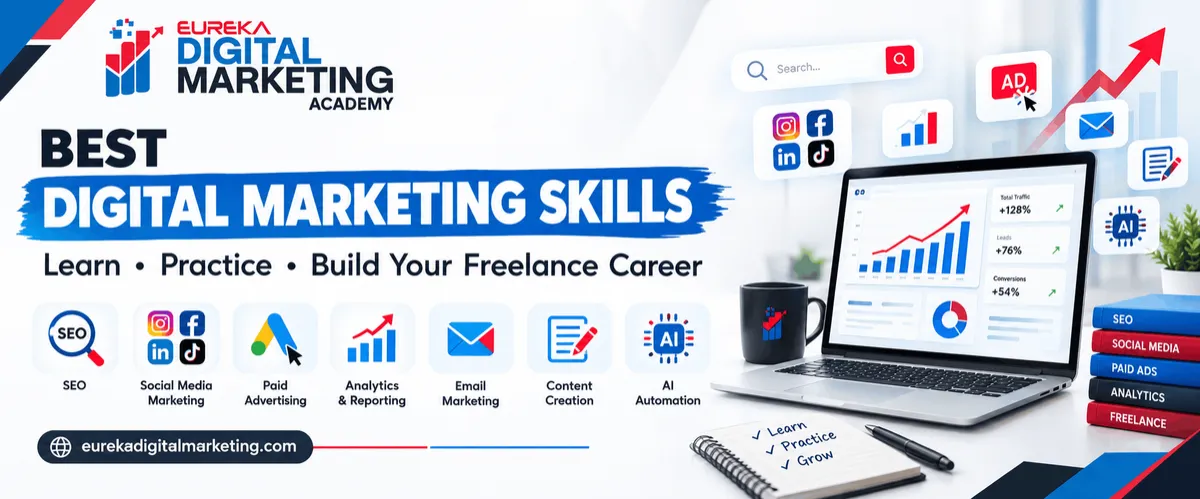
The best digital marketing skills to learn for freelance jobs include search engine optimization (SEO), social media marketing, paid advertising, content marketing, email marketing, analytics, and conversion rate optimization. These skills help freelancers improve online visibility, attract potential customers, and measure marketing performance.
Whether you are a beginner or looking to expand your existing services, choosing the right skills can help you build a strong portfolio, reach potential clients, and develop long-term professional relationships.
In this guide, you will learn which digital marketing skills are worth developing, how to practice them, and how to choose suitable training to prepare for freelance projects.
Why Are Digital Marketing Skills Important for Freelancers?
Businesses increasingly use digital channels to reach audiences, promote products, and generate leads. They need professionals who can plan campaigns, improve website performance, manage social media accounts, and evaluate results.
This creates opportunities for freelancers who can demonstrate practical expertise and communicate the value of their work.
Learning digital marketing skills for freelancing can help you:
Offer specialized services: Focus on SEO, paid advertising, content creation, or social media management.
Work with different industries: Apply your knowledge to e-commerce stores, educational institutes, local businesses, and other organizations.
Build a professional portfolio: Demonstrate your capabilities through sample campaigns, website audits, and content projects.
Develop recurring client relationships: Provide ongoing optimization, reporting, and campaign management.
Expand your career options: Use your experience to pursue freelance projects, remote employment, or digital marketing positions.
Before choosing a specialty, explore the digital marketing freelancing and career growth guide for a broader understanding of professional development and client opportunities.
1. Search Engine Optimization (SEO)
SEO is one of the most useful digital marketing skills for freelancers who want to help businesses improve their organic search visibility. It involves understanding search intent, optimizing website content, improving technical performance, and developing a relevant internal linking structure.
Freelancers with SEO knowledge can offer services to businesses that want to attract relevant visitors through search engines.
Essential SEO skills to learn
Keyword research: Identify relevant search terms based on user needs, competition, and business goals.
On-page SEO: Optimize title tags, meta descriptions, headings, URLs, and page content.
Technical SEO: Understand crawling, indexing, canonical tags, redirects, mobile usability, and website performance.
Content optimization: Improve existing pages and create useful content that matches search intent.
Internal linking: Connect related pages using descriptive and relevant anchor text.
SEO reporting: Use Google Search Console and analytics tools to evaluate impressions, clicks, traffic, and conversions.
How can you practice SEO for freelance jobs?
Start with a website you own or have permission to analyze. Research keywords, audit a few pages, recommend improvements, and document the results. You can also create a sample SEO strategy for a fictional business without presenting simulated results as real achievements.
To strengthen your knowledge, study the SEO starter guide for every platform. It covers SEO fundamentals, optimization, search intent, and analytics.
Freelance services you can offer: Keyword research, on-page SEO audits, content optimization, technical SEO checks, and monthly performance reporting.
2. Social Media Marketing and Management
Social media marketing helps businesses build brand awareness, engage audiences, distribute content, and generate leads. It is particularly useful for freelancers who enjoy creative work combined with marketing strategy.
Simply posting regularly is not enough. Professional social media management requires audience research, content planning, platform knowledge, performance analysis, and continuous improvement.
Essential social media marketing skills
Social media strategy development
Content calendars and campaign planning
Instagram, Facebook, LinkedIn, and TikTok content management
Creative briefing and visual content coordination
Social media copywriting and captions
Community management and audience engagement
Paid social advertising fundamentals
Engagement, reach, leads, and conversion analysis
How to develop social media skills
Choose a business niche and create a sample 30-day content calendar. Include post ideas, captions, creative concepts, publishing schedules, and measurable objectives. Explain why each content format fits the target audience.
You can explore 10 social media management skills you need to succeed to understand the capabilities required for effective campaign management.
Freelance services you can offer: Social media account management, content calendars, campaign planning, profile optimization, and monthly reporting.
3. Paid Advertising and PPC Campaign Management
Paid advertising allows businesses to reach specific audiences through platforms such as Google Ads and Meta Ads. Freelancers who understand campaign setup, audience targeting, budgeting, and conversion tracking can help clients manage advertising campaigns more effectively.
Because advertising involves client budgets, you should learn how to measure results before managing campaigns independently.
Important paid advertising skills
Campaign objectives and structure
Keyword targeting for search advertising
Audience segmentation and targeting
Ad copywriting and creative testing
Budget allocation and bidding fundamentals
Conversion tracking and attribution basics
A/B testing and campaign optimization
Return on ad spend (ROAS) and cost per acquisition (CPA) analysis
How to practice paid advertising
Begin with training environments, campaign simulations, or supervised projects. Learn how to create a campaign brief, choose an appropriate objective, define a target audience, and select relevant performance metrics.
Do not promise guaranteed sales or a specific return on investment. Results depend on factors such as the offer, competition, landing page, budget, and audience.
Freelance services you can offer: Google Ads campaign setup, paid social campaign management, ad copy development, conversion tracking audits, and performance reporting.
4. Content Marketing and Copywriting
Content marketing helps businesses attract and educate potential customers through useful articles, landing pages, social posts, email campaigns, and other resources. Copywriting focuses on communicating value and encouraging a relevant action.
These skills work together: content attracts attention, while effective copy helps readers understand what to do next.
Content marketing skills to learn
Content research and topic selection
Audience and search intent analysis
Blog writing and content optimization
Landing page copywriting
Headlines and calls to action
Content calendars and distribution
Brand voice and messaging
Content performance measurement
How to build content marketing experience
Choose a topic related to a real business objective. Develop an outline, research relevant keywords, write an article, and add appropriate calls to action. Then explain how the content supports awareness, consideration, or lead generation.
Learn more through the content marketing course and practical skills guide, which is relevant for anyone planning to develop content-focused marketing services.
Freelance services you can offer: Blog writing, website copy, SEO content briefs, landing page copy, content calendars, and content audits.
5. Email Marketing and Automation
Email marketing helps businesses communicate with subscribers, nurture leads, promote offers, and maintain customer relationships. Automation can make these processes more consistent by sending relevant messages based on user actions or predefined schedules.
Freelancers need to understand both the technical setup and the purpose of each message.
Essential email marketing skills
Email list organization and segmentation
Campaign planning and scheduling
Subject line and email copywriting
Welcome and follow-up sequences
Lead nurturing workflows
Basic marketing automation
Open, click, and conversion analysis
Consent, unsubscribe, and email deliverability fundamentals
How to practice email marketing
Create a sample welcome sequence for a fictional business. Define the audience, write several connected emails, and explain the goal of each message. Use a test environment to learn how automation triggers and reporting work.
Explore how to use email marketing to generate more leads for ideas on connecting email campaigns with lead generation.
Freelance services you can offer: Newsletter creation, email campaign management, welcome sequences, lead nurturing workflows, and email performance reporting.
6. Analytics and Performance Reporting
Analytics helps freelancers understand whether their marketing activities are producing useful results. Clients need more than screenshots of dashboards; they need clear explanations of what the data means and what should happen next.
For this reason, analytics is a valuable supporting skill across SEO, paid advertising, social media, and email marketing.
Analytics skills every freelancer should develop
Understanding marketing KPIs
Google Analytics fundamentals
Google Search Console reporting
Traffic source analysis
Lead and conversion tracking
Campaign performance comparisons
Spreadsheet-based reporting
Data interpretation and recommendations
How to practice analytics
Create a sample report that separates objectives, key metrics, findings, and recommended actions. For example, if a campaign attracts visitors but produces few leads, investigate the landing page, offer, audience relevance, and conversion tracking before recommending changes.
Study the analytics and strategy guide to learn how performance measurement supports digital marketing decisions.
Freelance services you can offer: Monthly marketing reports, SEO performance analysis, campaign dashboards, conversion tracking reviews, and KPI reporting.
7. Conversion Rate Optimization (CRO)
Conversion rate optimization focuses on improving the percentage of visitors who complete a desired action, such as submitting a form, requesting a consultation, or purchasing a product.
A freelancer who understands CRO can help businesses evaluate the customer journey instead of focusing only on traffic and impressions.
Key CRO skills
Landing page evaluation
User journey analysis
Calls-to-action optimization
Form usability assessment
A/B testing fundamentals
Conversion funnel analysis
Mobile user experience checks
Conversion tracking and measurement
How to practice CRO
Review a sample landing page and identify possible obstacles, such as unclear messaging, confusing navigation, lengthy forms, or weak calls to action. Prioritize improvements based on evidence and test them where suitable.
Avoid claiming that a proposed change will increase conversions until its impact has been measured.
Freelance services you can offer: Landing page audits, conversion funnel reviews, form optimization recommendations, and testing plans.
8. AI Tools and Marketing Automation
AI tools can help freelancers research topics, organize ideas, draft content, summarize reports, and streamline repetitive tasks. However, AI-generated output still requires human judgment, fact-checking, editing, and alignment with business objectives.
The most useful approach is to combine AI tools with a solid understanding of marketing fundamentals.
AI marketing skills to learn
AI-assisted content research
Prompt development for marketing tasks
Content editing and fact-checking
Automated workflow planning
Campaign reporting assistance
Marketing data interpretation
AI-supported creative brainstorming
Quality control and responsible data handling
How to use AI professionally
Build a repeatable workflow for one task, such as preparing a content brief or summarizing a campaign report. Compare the initial output with the final human-reviewed version and document where your expertise improved accuracy or usefulness.
AI should support your work, not replace strategic thinking or encourage you to share confidential client information with tools that are not approved for that data.
Freelance services you can offer: Marketing workflow setup, AI-assisted content workflows, reporting templates, and automation planning.
Which Digital Marketing Skills Should Beginners Learn First?
You do not need to master every marketing discipline before applying for freelance jobs. Start with a manageable combination of skills that can be developed and demonstrated through practical projects.
SkillBest starting projectPotential serviceSEOAudit five website pagesOn-page SEO auditSocial media marketingCreate a 30-day content calendarSocial media managementContent marketingWrite and optimize a blog articleContent writingPaid advertisingPrepare a sample campaign structureCampaign setup supportEmail marketingBuild a sample welcome sequenceEmail campaign creationAnalyticsPrepare a sample KPI reportPerformance reportingCROReview a landing pageConversion audit
If you are completely new, begin with SEO, content marketing, or social media management. These areas offer practical ways to create portfolio samples without immediately spending money on advertising.
Once you have a foundation, add analytics and a second specialization. For example, combining SEO with content marketing or social media management with paid advertising can help you provide more complete solutions.
How to Choose the Right Digital Marketing Course for Freelancing
A structured course can help you learn concepts in a logical order, practice with relevant tools, and receive feedback on your work. However, the best choice depends on your current experience, budget, career goals, and preferred learning method.
Before enrolling in a digital marketing course, consider the following factors.
1. Check the curriculum
Look for practical coverage of the skills you want to sell. Depending on your chosen specialty, this could include SEO, keyword research, social media strategy, Google Ads, content marketing, analytics, or automation.
2. Look for hands-on projects
A useful training program should give you opportunities to apply concepts through exercises, campaign planning, website audits, content creation, or supervised practical work.
3. Evaluate trainer support
Feedback can help you identify mistakes and improve your work. Check whether the program offers guidance, project reviews, or opportunities to ask questions.
4. Review portfolio-building opportunities
Your goal should be to finish training with work samples that demonstrate your abilities. A certificate can support your profile, but it does not replace evidence of practical skills.
5. Compare the cost and learning format
Compare course duration, curriculum, practical exercises, trainer support, and total cost. Choose a program that fits your needs rather than assuming the most expensive option is automatically the best.
If you want structured learning, explore Eureka Digital Marketing Academy's digital marketing certification program. Review the current curriculum and available learning arrangements to determine whether they match your career goals.
How to Turn Digital Marketing Skills Into Freelance Jobs
Learning a skill is only the first step. You must also show potential clients what you can do, communicate clearly, and define services that solve specific problems.
Follow this process to prepare for your first freelance opportunities.
Step 1: Choose a clear niche
Select one primary service based on your interests and abilities. Examples include SEO for small businesses, social media management for local brands, or content marketing for educational websites.
A focused offer is usually easier to explain than a long list of unrelated services.
Step 2: Build a portfolio
Prepare two or three relevant samples. These might include an SEO audit, content calendar, landing page review, or sample campaign plan.
If the work is hypothetical, label it clearly as a sample project. Never invent client results, testimonials, or campaign performance.
Step 3: Package your services
Describe exactly what a client receives. An SEO starter package, for example, might include a keyword list, optimization recommendations, and a prioritized action plan.
Define deliverables, turnaround time, revision limits, reporting, and project scope before agreeing to work.
Step 4: Create a professional profile
Develop a clear profile on suitable freelance marketplaces or professional networks. Explain your specialization, the problems you help solve, and the type of work you can demonstrate.
Use portfolio links and relevant case studies to support your claims.
Step 5: Find and approach potential clients
Research businesses that may benefit from your services. Personalize your outreach by identifying a relevant opportunity and explaining how you would investigate it.
Avoid generic messages, misleading promises, and unsolicited claims that guarantee rankings or sales.
Step 6: Deliver, report, and improve
Agree on objectives and measurements before starting a project. Communicate progress, explain limitations, and provide recommendations supported by evidence.
Consistent delivery and clear communication can help you develop repeat business and professional referrals.
For more specific guidance, read how to get high-paying digital marketing clients as a freelancer and how to build a digital marketing portfolio with no experience.
Common Mistakes to Avoid When Learning Digital Marketing Skills
Beginners can waste time by trying to learn everything at once or focusing on certificates instead of practical competence. Avoid these common mistakes:
Learning too many skills simultaneously: Develop one primary specialty before expanding.
Ignoring practical experience: Apply concepts through real or clearly labeled sample projects.
Relying entirely on AI: Review facts, context, strategy, and quality before delivering work.
Using vanity metrics alone: Connect marketing performance to relevant objectives, such as qualified leads or conversions.
Promising guaranteed results: Explain the work you will perform without guaranteeing outcomes outside your control.
Failing to communicate: Set clear expectations, deadlines, deliverables, and reporting schedules.
Neglecting continuous learning: Update your knowledge as tools, platforms, and marketing practices change.
Frequently Asked Questions
Which digital marketing skills are best for freelance jobs?
SEO, social media marketing, paid advertising, content marketing, email marketing, analytics, and conversion rate optimization are useful options. The best skill depends on your interests, client demand, and ability to demonstrate results.
Can I start digital marketing freelancing with no experience?
Yes. You can begin learning without previous professional experience, but you should develop practical skills before taking on complex client work. Start with sample projects, practice tasks, and a portfolio that accurately represents your abilities.
Do I need a digital marketing certificate to get freelance jobs?
A certificate is not always required. Clients may place more importance on relevant samples, clear communication, practical knowledge, and evidence that you understand their objectives. Training can still provide structure and help you develop foundational skills.
How long does it take to learn digital marketing for freelancing?
The timeline varies according to your starting knowledge, chosen specialty, study schedule, and practice. Focus on mastering a defined set of tasks and building credible samples rather than relying on a fixed deadline.
Which digital marketing skill should I learn first?
SEO, content marketing, and social media management are reasonable starting points for many beginners. Choose one based on your interests and available practice opportunities, then add complementary skills as your confidence grows.
Can I learn multiple digital marketing skills?
Yes. Start with one core specialty and develop complementary skills over time. For example, SEO and content marketing work well together, while social media management and paid advertising can complement each other.
Final Thoughts
The best digital marketing skills to learn for freelance jobs are the ones you can apply consistently to real business problems and demonstrate through credible work samples. SEO, social media marketing, paid advertising, content creation, email marketing, analytics, and CRO each offer different ways to support business growth.
Rather than learning every tool at once, choose a specialty, practice with structured projects, build a portfolio, and learn how to communicate the value of your services. When you are ready to expand your expertise, consider a structured digital marketing training program that combines relevant concepts with practical application.
A strong foundation, continuous improvement, and professional client communication can help you build a more sustainable freelance career.