Content Marketing Course: What Should You Learn to Build Real-World Skills?
Content marketing has become an essential part of modern digital marketing. Businesses use valuable content to attract audiences, build trust, increase visibility, and support conversions. However, simply knowing how to write a blog or create a social media post is not enough to become a successful content marketer.
A well-structured content marketing course can help learners understand how content works across different digital channels while developing practical skills they can use in real marketing campaigns. Whether you are a beginner, aspiring digital marketer, business owner, or marketing professional, choosing the right content marketing training can help you build a stronger foundation for your career.
What Should You Learn in a Content Marketing Course?
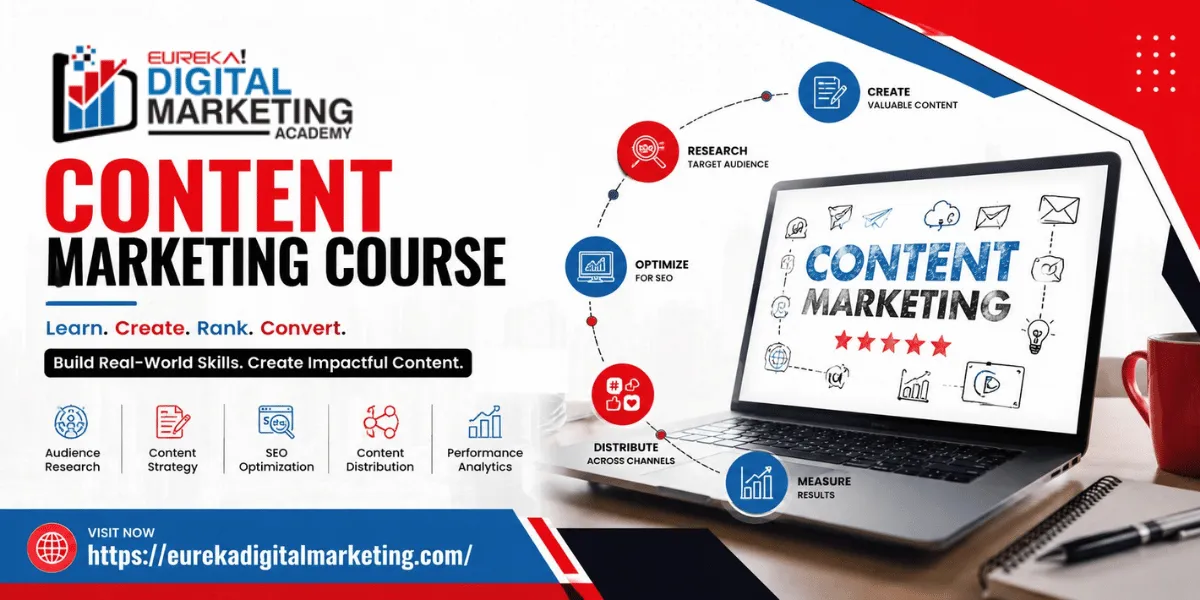
A good course should go beyond basic definitions and theory. It should teach you how to research an audience, develop a content strategy, create useful content, optimize it for search engines, distribute it through appropriate channels, and measure its performance.
The goal should be to develop content marketing skills that can be applied to real businesses rather than simply completing lessons and memorizing concepts.
Here are some of the most important areas a practical course should cover.
1. Understanding the Content Marketing Process
Before creating content, you need to understand why businesses create it and how it contributes to their marketing goals.
A practical content marketing course for beginners should introduce the complete content marketing process, including:
Audience research
Content planning
Content creation
Search optimization
Content distribution
Performance measurement
Content improvement
Understanding this process allows learners to see how individual pieces of content fit into a larger digital marketing strategy.
Instead of treating every blog, video, or social media post as an isolated activity, you learn to create content with a specific purpose and target audience in mind.
2. Audience and Customer Research
One of the most important content marketing skills is knowing what your audience actually needs.
Effective content starts with understanding your target customers. You should learn how to identify their questions, problems, interests, search behavior, and buying journey.
For example, someone searching for “how to improve website traffic” may still be researching solutions, while someone searching for a specific digital marketing course may already be evaluating their options.
A strong content marketing training program should teach you how to understand these different stages and create content that matches the audience's intent.
3. Keyword Research and Search Intent
SEO and content marketing are closely connected. If your content cannot be discovered through search engines, it may struggle to reach the right audience.
That is why content marketing course online programs should ideally include keyword research and search intent.
You should learn how to:
Find relevant keywords
Identify informational and commercial intent
Understand search queries
Group related keywords
Select primary and secondary keywords
Create content around user needs
Keyword research should not mean inserting the same phrase repeatedly into an article. Instead, it should help you understand what people are searching for and what type of information they expect to find.
4. Developing a Content Strategy
Creating content randomly can waste time and resources. A professional content marketer needs a clear strategy.
A content marketing strategy course should teach you how to connect content with business objectives. You should understand how to select topics, prioritize opportunities, create content clusters, and establish a publishing schedule.
A basic strategy may include:
Defining the target audience
Establishing marketing goals
Researching keywords and topics
Creating content pillars
Developing supporting content
Planning distribution
Measuring results
This approach helps transform content creation from an occasional activity into a structured marketing process.
5. Creating High-Quality Content
Content creation is another core part of any content marketing course.
However, effective content is not simply about producing a large number of words. It should provide useful information, answer the audience's questions, maintain a clear structure, and encourage the reader to take an appropriate next step.
Learners should develop practical abilities in:
Blog writing
Content research
Headline creation
Content structuring
Copywriting
Editing and proofreading
Creating calls to action
A good course should also explain how content requirements differ between blogs, landing pages, emails, social media, and other digital channels.
6. SEO Content Optimization
Creating useful content is only one part of the process. You also need to understand how to make that content easier for search engines and users to understand.
An effective content marketing training program should introduce fundamental SEO practices such as:
Optimizing titles and headings
Using keywords naturally
Improving content structure
Writing useful meta descriptions
Creating internal links
Addressing search intent
Improving readability
The focus should remain on creating content for people first while using SEO techniques to improve discoverability.
7. Content Distribution
Publishing an article does not automatically guarantee that people will find it.
That is why learners should understand different content distribution channels. Depending on the business and audience, content can be distributed through search engines, social media, email marketing, online communities, and other relevant platforms.
A practical content marketing course online should explain how to choose the right distribution channel based on the target audience and content format.
For example, a detailed educational article may perform well through organic search, while short-form content may be more suitable for social media platforms.
8. Building a Content Calendar
Consistency is another important part of successful content marketing.
A content calendar helps marketers organize topics, publishing dates, content formats, target audiences, keywords, and distribution channels.
During content marketing classes, learners should ideally practice creating a simple content calendar rather than only learning the concept theoretically.
A basic calendar can help answer questions such as:
What should we publish?
When should we publish it?
Which audience are we targeting?
Which keyword or topic are we targeting?
Where will the content be distributed?
What is the purpose of the content?
This makes content production more organized and easier to manage.
9. Measuring Content Performance
Another important skill is understanding whether your content is actually producing results.
A professional content marketing course should introduce basic performance measurement. Depending on the campaign, useful metrics can include organic traffic, rankings, engagement, leads, conversions, and other business-related outcomes.
The purpose of analytics is not simply to collect numbers. It is to understand what is working and what needs improvement.
For example, if an article receives significant traffic but generates very few conversions, the marketer may need to improve its calls to action, internal linking, content relevance, or conversion path.
10. Developing Practical Content Marketing Skills
The biggest difference between theoretical learning and practical learning is application.
When evaluating a content marketing certification or training program, look for opportunities to work on realistic projects. Practical assignments can help learners apply concepts such as keyword research, content planning, writing, optimization, and performance analysis.
Useful projects might include:
Creating a content strategy
Developing a keyword-based topic plan
Writing and optimizing a blog
Building a content calendar
Creating a content cluster
Developing a distribution plan
Reviewing content performance
These activities can make the learning process more meaningful and help build confidence.
Can Beginners Learn Content Marketing?
Yes. You do not necessarily need advanced marketing experience to start learning content marketing.
A structured content marketing course for beginners can introduce the fundamentals step by step, beginning with audience research and content planning before moving into SEO, distribution, analytics, and strategy.
However, beginners should avoid choosing a course based only on its title or certificate. Look at the curriculum, practical assignments, learning structure, and skills the course is designed to develop.
The best program for you will depend on your current knowledge and your career goals.
Is Content Marketing a Useful Digital Marketing Skill?
Content marketing can complement many other digital marketing skills. Professionals working in SEO, social media, email marketing, paid advertising, and brand marketing can all benefit from understanding how content supports the customer journey.
Learning content marketing can therefore help you build a broader understanding of digital marketing rather than limiting your knowledge to content creation alone.
For aspiring digital marketers, combining content strategy, SEO, audience research, analytics, and communication can create a stronger professional skill set.
How to Choose the Right Content Marketing Course
Before enrolling in a program, consider whether it provides both foundational knowledge and practical application.
Look for a course that includes:
Content strategy
Audience research
Keyword research
SEO content optimization
Content creation
Content distribution
Content performance analysis
Practical projects
Real-world examples
You should also consider whether the course matches your experience level. Beginners may need a structured introduction, while experienced marketers may benefit more from advanced strategy and analytics.
A content marketing certification can be useful as part of your professional development, but the skills you can demonstrate are ultimately more important than the certificate itself.
Final Thoughts
A strong content marketing course should teach much more than how to write content. It should help you understand audiences, research topics, develop strategies, create valuable content, optimize it for search, distribute it effectively, and measure its results.
If your goal is to learn content marketing, prioritize practical learning over theory alone. The ability to develop a content strategy, conduct keyword research, create useful content, optimize pages, and evaluate performance can help you build content marketing skills that are relevant to real digital marketing work.
Whether you choose online learning, structured content marketing training, or classroom-based content marketing classes, focus on a program that gives you opportunities to practice what you learn. That practical experience is what can turn content marketing knowledge into real-world digital marketing capability.