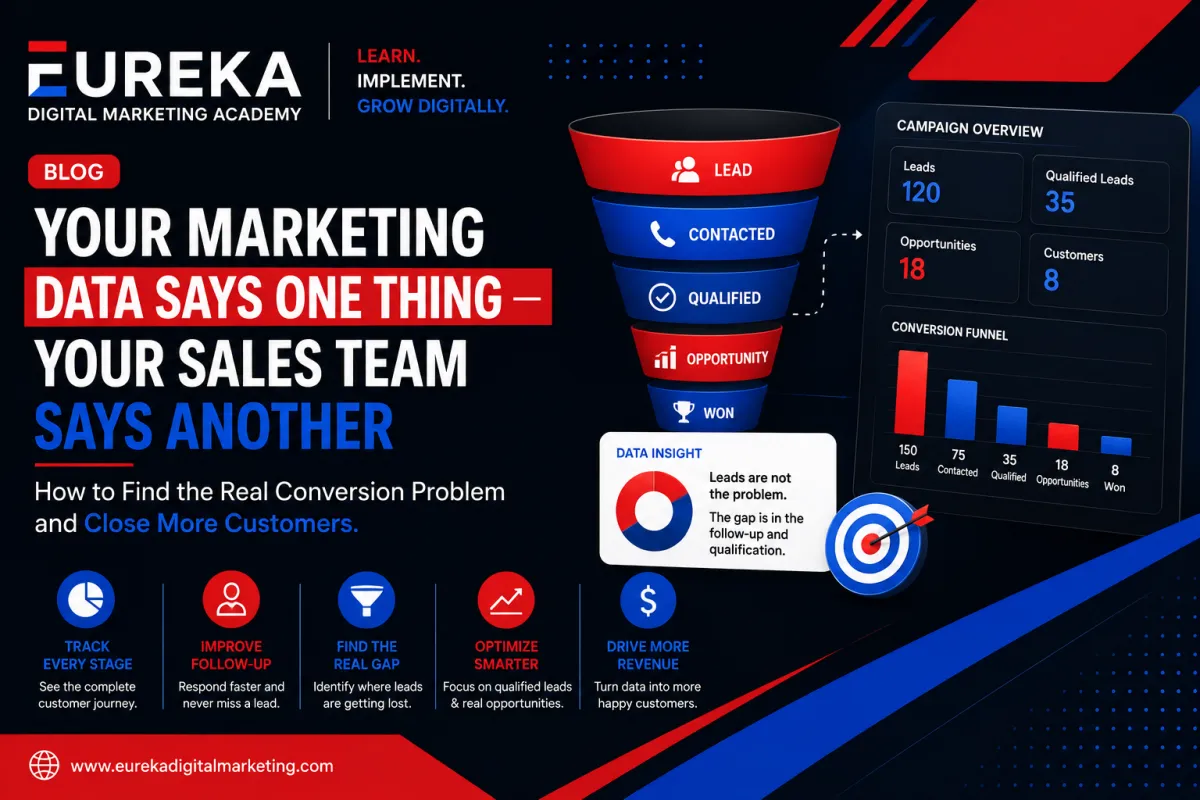
Your Marketing Data Says One Thing — Your Sales Team Says Another: How to Find the Real Conversion Problem
Your Meta Ads dashboard says you generated 120 leads this month.
Your CRM says there are 96.
Your sales team says they only spoke to 54 people.
And somehow, the business only closed 8 sales.
So which number is correct?
This is one of the most frustrating problems in digital marketing: marketing reports a successful campaign while the sales team says the leads are poor.
The problem usually isn't that someone is lying.
The problem is that your marketing, CRM, and sales systems are measuring different parts of the customer journey.
If you want to find the real conversion problem, you need to connect those pieces.
The Funnel Doesn't End When Someone Submits a Form
Many marketers define a conversion as:
Ad → Form Submission → Lead
But a form submission isn't necessarily a business conversion.
A person can submit a form and then:
Ignore the follow-up call
Enter the wrong phone number
Submit the form accidentally
Ask for information but have no buying intent
Become unreachable
Fail to meet the company's requirements
Decide not to purchase
That's why businesses need to distinguish between a lead and a qualified lead.
For example:
100 form submissions
↓
80 valid contacts
↓
50 contacted
↓
30 qualified leads
↓
15 opportunities
↓
8 customers
Now you can see where the real problem is.
If you only report the original 100 form submissions, the campaign might look fantastic.
If only 8 became customers, however, the business may see a completely different story.
Start With One Source of Truth
The first step is making sure your systems agree on what a conversion actually means.
Your advertising platform might define a conversion as a form submission.
Your CRM might define it as a new contact.
Your sales team might define it as a qualified prospect.
And the business owner might define it as someone who actually paid.
All four definitions can technically be correct.
But they shouldn't be confused with each other.
Create clear funnel stages such as:
Lead → Contacted → Qualified → Opportunity → Won
Then make sure every lead can be tracked through those stages.
This gives you something far more useful than a simple lead count:
conversion visibility across the entire funnel.
Your Lead Count Can Be Misleading
Imagine Campaign A produces 200 leads at $5 each.
Campaign B produces 80 leads at $15 each.
At first glance, Campaign A looks like the obvious winner.
But after sales follow-up:
Campaign A: 200 leads → 10 customers
Campaign B: 80 leads → 20 customers
Campaign B generated fewer leads but twice as many customers.
Its cost per lead was higher, but its cost per acquisition was lower.
That's why optimizing exclusively for cheap leads can create a dangerous illusion of success.
The cheapest lead isn't necessarily the most valuable lead.
Find Where the Funnel Breaks
When marketing and sales disagree, don't ask:
“Who's right?”
Ask:
“At which stage does the data start diverging?”
This is the most important diagnostic question.
Suppose your numbers look like this:
Funnel StageNumberLeads generated150Valid contacts120Successfully contacted75Qualified35Opportunities18Customers6
Now the problem becomes much easier to investigate.
If only 50% of leads are being contacted, you may have a sales follow-up problem.
If many people are contacted but very few qualify, you may have a lead-quality or targeting problem.
If many qualified prospects don't purchase, you may have an offer, pricing, sales-process, or product problem.
The campaign itself might be perfectly fine.
Speed-to-Lead Can Change Everything
One commonly overlooked variable is how quickly the business responds to new leads.
Someone who submits a form because they're interested right now may not feel the same way three days later.
That's why automation can be extremely valuable.
For example:
Form submitted
↓
Instant confirmation SMS/email
↓
Lead assigned to salesperson
↓
Salesperson receives notification
↓
Call attempt
↓
Follow-up sequence
Now the business isn't relying on someone manually checking a spreadsheet hours later.
The faster and more consistently you respond, the less opportunity you lose between lead generation and sales conversation.
Audit the CRM, Not Just Ads Manager
If your ads are generating leads but sales aren't appearing, open the CRM.
Look at individual records.
Check:
Was the lead actually created?
Is the phone number valid?
Was the lead assigned to someone?
Was the lead contacted?
How long did the first response take?
Was the lead qualified?
Was the opportunity created?
Was the opportunity marked won or lost?
Is the revenue attached to the correct source?
This can reveal problems that an advertising dashboard will never show you.
For example, Meta may report 100 leads while your CRM contains only 70 because something broke between the form and CRM.
That isn't an advertising problem.
It's a data-transfer problem.
Attribution Gets Complicated Fast
Another major issue is attribution.
A customer might:
See your Facebook ad.
Visit your website.
Leave.
Search your brand on Google later.
Return through organic search.
Call your business.
Purchase.
Which channel gets credit?
Depending on your reporting system, the answer could be Facebook, Google, organic search, direct traffic, or even the salesperson's manually entered source.
This is why marketers need to understand that attribution models are measurement frameworks, not perfect representations of reality.
Instead of asking:
“Which channel deserves 100% of the credit?”
Ask:
“Which channels are consistently contributing to qualified opportunities and revenue?”
That produces a much more useful business question.
Connect Marketing Metrics to Revenue
Your reporting should eventually move beyond:
Impressions → Clicks → Leads
and toward:
Spend → Leads → Qualified Leads → Opportunities → Customers → Revenue
Then you can calculate metrics that actually matter.
For example:
Cost per Lead
Marketing Spend ÷ Leads
Cost per Qualified Lead
Marketing Spend ÷ Qualified Leads
Customer Acquisition Cost
Marketing Spend ÷ New Customers
ROAS
Revenue ÷ Advertising Spend
Now your marketing team and sales team are looking at the same journey.
What If the Leads Really Are Bad?
Sometimes the sales team is right.
If your CRM shows that most leads are irrelevant, unqualified, or outside your target market, the solution isn't to tell salespeople to “follow up harder.”
Go back to the campaign.
Investigate:
Targeting
Creative messaging
Lead form questions
Offer
Landing page
Campaign objective
Audience intent
Your ad might be attracting the wrong people because your message is too broad.
For example, advertising:
“Get a Free Quote Today!”
can attract a much wider audience than:
“Get a Free Quote for Commercial HVAC Installation.”
The second message creates stronger qualification before the person even submits the form.
The Real Goal Isn't More Leads
This is the biggest lesson.
A business doesn't actually want more form submissions.
It wants more profitable customers.
Leads are simply one step in that process.
So when your marketing dashboard says:
“Great news! We generated 500 leads!”
but the sales team says:
“We only got five customers.”
Don't immediately increase your ad budget.
Don't immediately replace the sales team.
And don't immediately blame the algorithm.
Audit the entire funnel.
Find the exact stage where people are disappearing.
Because once you know whether the problem is tracking, lead quality, follow-up, qualification, sales conversion, attribution, or the offer, you can finally fix the right problem.
And that's what good digital marketing should do.
Not just generate numbers that look impressive in a dashboard — but connect marketing activity to actual business growth.