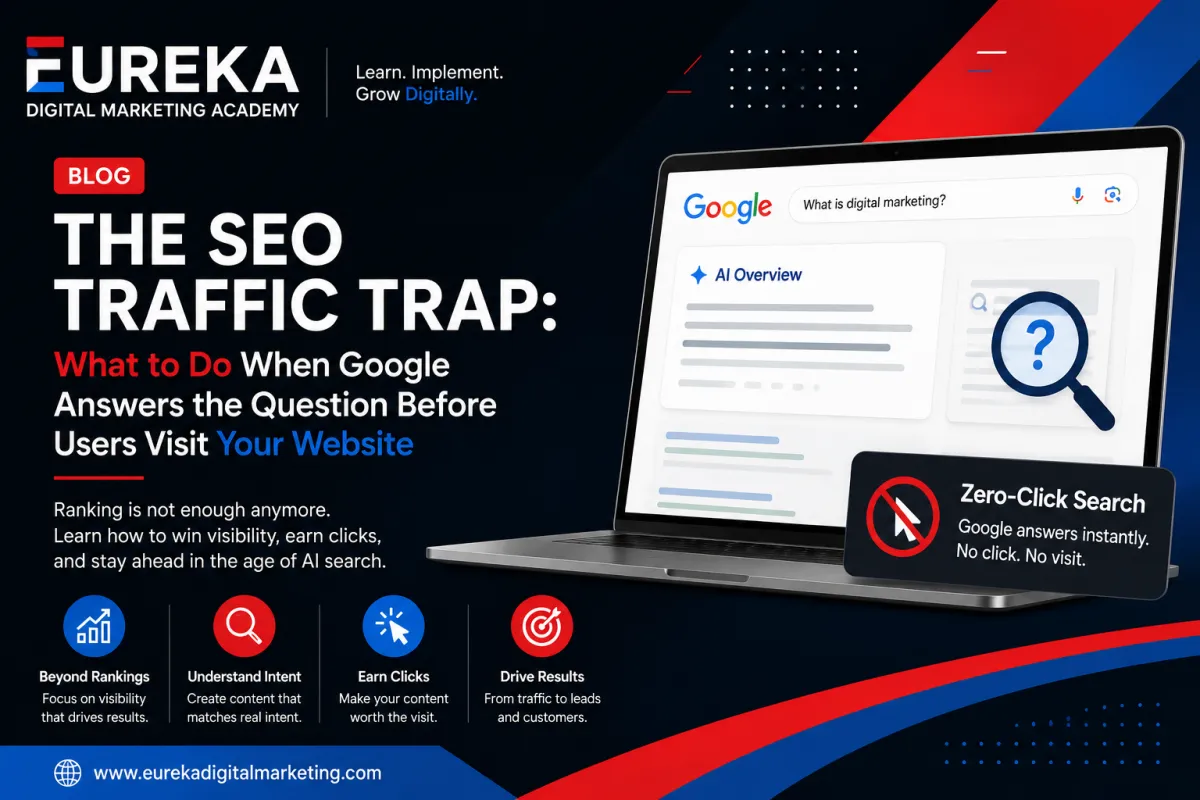
The SEO Traffic Trap: What to Do When Google Answers the Question Before Users Visit Your Website
You finally got the ranking you wanted.
Your page reached the first page of Google. Maybe it even reached position #1. You expected organic traffic to climb, but instead, your analytics dashboard tells a very different story.
You're ranking — so where are the clicks?
The answer increasingly lies in how Google itself is changing the search experience.
AI Overviews and AI Mode can now answer questions directly inside Google, meaning users may get the information they need without visiting a website. A recent 2026 study of real Google searches found that clicks to sources cited inside AI Overviews occurred in only about 1% of visits where an AI Overview appeared.
This doesn't mean SEO is dead.
It means the definition of SEO success is changing.
What Is the Zero-Click Search Problem?
A zero-click search happens when someone searches for something on Google but doesn't click through to a website.
This isn't entirely new.
Featured snippets, knowledge panels, local packs, calculators, definitions, and other SERP features have been answering searches directly for years.
But AI-powered search makes the effect much bigger.
Instead of simply displaying one extracted answer, Google's AI features can synthesize information from multiple sources and provide a conversational response directly on the results page.
Google itself says AI Overviews and AI Mode are designed to help users understand complicated topics and explore supporting links when they want to go deeper.
That creates a difficult situation for publishers:
Your content can help answer the user's question without receiving the user's click.
Ranking #1 Doesn't Guarantee Traffic Anymore
Traditional SEO taught us a relatively straightforward formula:
Higher ranking → more visibility → more clicks → more traffic.
That relationship is becoming less predictable.
Imagine someone searches:
“What is technical SEO?”
Google can potentially provide a concise explanation directly in the search results.
The user gets the answer.
No click.
Now imagine your article is ranking #1 for that query.
You technically won the ranking competition, but you may still lose the traffic competition.
That's the SEO traffic trap.
The solution isn't to stop targeting informational keywords. Instead, marketers need to understand which searches deserve clicks and which searches are likely to be satisfied directly in the SERP.
Not Every Keyword Has the Same Traffic Potential
Before creating an article, ask:
“If I rank for this keyword, will the searcher actually need my website?”
Consider a query like:
“What is a meta description?”
The user probably wants a quick definition.
Compare that with:
“How do I create a meta description strategy for 500 product pages?”
The second search requires deeper information, examples, processes, and potentially tools.
That creates a stronger reason to visit a website.
Look for keywords involving:
Comparisons
Detailed tutorials
Original research
Case studies
Product evaluations
Templates
Tools
Calculations
Real-world examples
Industry-specific solutions
The goal isn't simply to find keywords with high search volume.
Find keywords where your website provides something the search results cannot easily summarize.
Stop Optimizing Only for Rankings
Ranking should still matter.
Google explicitly says its foundational SEO practices remain relevant for AI Overviews and AI Mode. It recommends helpful, reliable, people-first content, strong internal linking, crawlability, good page experience, textual content, and accurate structured data.
But rankings shouldn't be your only KPI.
Start monitoring:
Impressions → Clicks → CTR → Engagement → Leads → Sales
A page receiving 100,000 impressions and 200 clicks might look impressive in a report.
But if another page receives 10,000 impressions, 800 clicks, and 50 qualified leads, the second page may be far more valuable.
SEO isn't ultimately about collecting impressions.
It's about creating business value from search visibility.
Make Your Content Worth Clicking
If Google can summarize your article in three sentences, you need to give people a reason to want the other 1,500 words.
That doesn't mean deliberately hiding the answer.
Give the reader the answer quickly.
Then give them something more valuable than the answer itself.
For example, don't write:
“What is Facebook advertising?”
and spend 2,000 words defining it.
Instead, build something like:
“How We Would Build a $1,000/Month Facebook Ads Campaign for a Local Business.”
Now you can include:
Campaign structure
Budget allocation
Audience strategy
Creative examples
Testing framework
Optimization decisions
Common mistakes
Real scenarios
The searcher isn't just looking for information anymore.
They're looking for implementation.
That's much harder to replace with a short AI-generated answer.
Build Content Around First-Hand Value
This is where modern SEO becomes particularly interesting.
Google's guidance emphasizes creating unique, satisfying content rather than commodity information.
Think about what your organization knows that competitors don't.
That could be:
Original case studies
Customer experiences
Expert interviews
Campaign results
Proprietary data
Screenshots
Experiments
Step-by-step processes
Industry-specific examples
Personal observations
If 50 websites explain the same concept, Google has plenty of interchangeable information to choose from.
But if your page contains original evidence, it becomes much harder to replace.
Don't Ignore AI Search Visibility
There's another important shift happening.
The objective isn't necessarily:
“How do I prevent Google from answering my question?”
Instead, consider:
“How do I make my brand one of the sources Google trusts when answering it?”
Google says AI features can surface supporting links from its search index and that the same fundamental SEO principles apply.
Google also began rolling out dedicated Search Console reporting in 2026 for visibility within generative AI features, including AI Overviews and AI Mode, although the new reporting is initially available only to a subset of sites.
That means marketers should increasingly think about visibility, citations, branded searches, clicks, and conversions together.
What Should SEO Marketers Do Now?
Here's a practical framework.
1. Audit your declining pages
Find pages where:
Rankings are stable + impressions are stable + clicks are falling.
Those are prime candidates for SERP-feature or zero-click analysis.
2. Identify the search intent
Ask whether the query requires:
A definition, a decision, an implementation, or an experience.
Definitions are easier to answer directly.
Implementation and experience usually create stronger reasons to click.
3. Add unique value
Bring in examples, data, screenshots, expert opinions, original research, or practical frameworks.
4. Strengthen internal linking
Help users move from informational content toward deeper resources, tools, services, or conversion pages.
Google specifically recommends making important content easily discoverable through internal links.
5. Measure business outcomes
Don't celebrate rankings without checking what happens afterward.
Ask:
Did organic visitors engage?
Did they become leads?
Did they purchase?
Did branded searches increase?
Did the content contribute to conversions?
SEO Isn't Dead. The Old Measurement Model Is.
The biggest mistake marketers can make in 2026 is treating SEO as a simple race to position #1.
Search has become an ecosystem.
Sometimes the winning result is the website that gets the click.
Sometimes it's the brand that gets cited in an AI answer.
And sometimes the real win happens later, when that user remembers the brand and searches for it directly.
So if you're ranking well but watching your traffic stagnate, don't immediately conclude that your SEO strategy has failed.
First ask a better question:
“What is Google doing with the searcher's intent before they ever reach my website?”
Once you understand that, you can stop chasing rankings for their own sake and start building content that earns something far more valuable:
visibility, trust, clicks, and ultimately customers