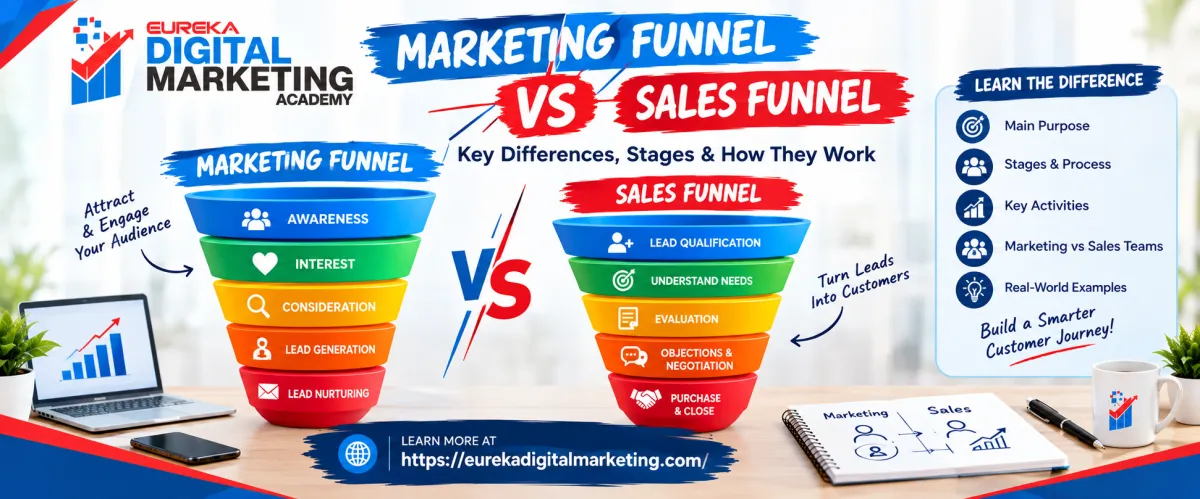
Marketing Funnel vs Sales Funnel: Key Differences, Stages & How They Work
Businesses often use the terms marketing funnel and sales funnel interchangeably, but they are not exactly the same. Both are connected to the customer journey, yet they focus on different parts of the process.
A marketing funnel generally focuses on attracting audiences, creating awareness, generating interest, and developing potential customers. A sales funnel focuses more closely on qualifying prospects, handling purchase decisions, and converting opportunities into customers.
Understanding the difference between a marketing funnel vs sales funnel can help businesses create a more organized customer acquisition process and improve coordination between marketing and sales activities.
What Is a Marketing Funnel?
A marketing funnel represents the stages a person moves through as they become aware of a business, develop interest, and potentially become a qualified lead.
The marketing funnel commonly includes:
Awareness
Interest
Consideration
Lead generation
Lead nurturing
The exact stages can vary depending on the business model and customer journey.
At the top of the funnel, a person may not know much about the brand or may simply be researching a problem. Marketing activities help introduce the business, educate the audience, and create interest.
For a broader explanation of funnel concepts and different funnel models, you can explore what a funnel is and the different types of funnels.
What Is a Sales Funnel?
A sales funnel focuses more specifically on moving prospects toward a purchase or another sales-related conversion.
Once a person becomes a potential customer, the sales process may involve:
Lead qualification
Identifying customer needs
Product or service evaluation
Handling objections
Sales conversations
Proposal or offer
Purchase decision
Closing the sale
The sales funnel is therefore closely connected to the buying process and sales pipeline.
For a business selling high-value services, for example, a prospect might first submit an inquiry, speak with a salesperson, receive a proposal, and then decide whether to purchase.
Marketing Funnel vs Sales Funnel: The Main Difference
The simplest way to understand the difference is to look at their primary focus.
Marketing funnel: Attracts and develops potential customers.
Sales funnel: Moves qualified prospects toward a purchase.
Marketing usually operates earlier in the customer journey, while sales becomes increasingly involved as prospects demonstrate stronger buying intent.
However, the two funnels are not completely separate systems. They often overlap and work together.
Marketing Funnel vs Sales Funnel Comparison
FactorMarketing FunnelSales FunnelMain purposeAttract and develop potential customersConvert prospects into customersPrimary focusAwareness, interest, and lead generationQualification, evaluation, and purchaseMain audienceBroad audience and prospectsQualified prospects and opportunitiesTypical activitiesContent, SEO, social media, advertising, emailCalls, demos, proposals, negotiationsMain objectiveGenerate and nurture demandGenerate sales and revenueCommon metricsTraffic, engagement, leads, MQLsOpportunities, close rate, salesMain teamsMarketingSalesCustomer stageEarlier journeyLater buying journey
The exact structure varies between organizations, but this comparison provides a useful framework for understanding how marketing and sales processes connect.
Marketing Funnel Stages
1. Awareness
The awareness stage is where potential customers first discover a business, product, service, or solution.
Businesses can create awareness through:
SEO
Blog content
Social media
Paid advertising
Videos
Educational resources
Search marketing
At this point, the person may not be ready to buy.
The objective is to reach a relevant audience and help them understand a problem, need, or possible solution.
2. Interest
After discovering the business, some visitors may want to learn more.
They may:
Read multiple blog posts
Visit service pages
Watch videos
Follow social media accounts
Download resources
Subscribe to emails
The marketing team can use useful content and relevant messaging to maintain audience engagement.
3. Consideration
At the consideration stage, prospects are actively evaluating possible solutions.
They may compare:
Products
Services
Features
Pricing
Providers
Reviews
Benefits
Alternatives
This is where educational content, case studies, demonstrations, testimonials, and detailed service information can become particularly useful.
4. Lead Generation
A visitor can become a lead by taking an action such as:
Filling out a form
Requesting a consultation
Downloading a resource
Registering for an event
Requesting a quote
Signing up for a newsletter
Your existing guide on how to generate more leads through digital marketing covers several channels and tactics businesses can use to attract and capture potential customers.
5. Lead Nurturing
Not every lead is immediately ready for sales.
Lead nurturing keeps prospects engaged through relevant communication and useful information.
Email campaigns, educational content, follow-ups, case studies, and personalized communication can help prospects continue through the buyer journey.
Sales Funnel Stages
1. Lead Qualification
Once leads enter the sales process, businesses can determine whether they are suitable prospects.
Qualification may consider:
Business needs
Budget
Requirements
Purchase timeline
Decision-making authority
Product or service fit
This helps sales teams prioritize opportunities.
2. Discovery
During the discovery stage, the sales team learns more about the prospect's specific situation.
Questions might focus on:
What problem are you trying to solve?
What solution are you currently using?
What are your goals?
What challenges are you experiencing?
What outcome do you want?
This information helps the salesperson understand whether the offering is appropriate.
3. Evaluation
The prospect may now compare the company's solution with other options.
They may evaluate:
Features
Benefits
Pricing
Service quality
Implementation
Support
Expected results
The sales team can provide relevant information and answer questions during this stage.
4. Proposal or Offer
For service businesses and B2B companies, the next step may involve a proposal, quotation, package, or customized offer.
The proposal should clearly communicate:
What is included
Pricing
Deliverables
Timeline
Terms
Expected next steps
5. Purchase Decision
The prospect decides whether to move forward.
At this point, common barriers may include:
Price
Lack of trust
Unclear value
Timing
Internal approval
Comparison with competitors
Clear communication and relevant information can help the prospect make an informed purchase decision.
6. Closing
The final sales stage is where the prospect becomes a customer.
The action could involve:
Signing a contract
Making a payment
Purchasing a product
Starting a subscription
Booking a service
After conversion, the customer can move into onboarding, retention, and relationship-building activities.
How Marketing and Sales Funnels Work Together
The marketing funnel and sales funnel should not operate as completely separate systems.
Instead, they can form one connected customer acquisition process.
A simplified journey might look like this:
Marketing → Awareness → Interest → Lead → Qualification → Sales → Purchase
Marketing attracts and develops potential customers.
Sales takes qualified opportunities and works toward conversion.
This relationship is particularly important when businesses have multiple customer touchpoints before a purchase.
For example:
Blog post → Landing page → Lead form → Email nurturing → Sales call → Proposal → Customer
Each step contributes to the overall buyer journey.
Marketing Funnel vs Sales Funnel: Where Do They Overlap?
There is no universal point where one funnel suddenly ends and the other begins.
The overlap can occur around:
Lead qualification
Lead scoring
Nurturing
Product evaluation
Sales-ready leads
Follow-up
Conversion
For example, marketing may identify a lead as highly engaged based on their actions. The sales team can then review the lead and determine whether it is ready for direct contact.
This is why communication between marketing and sales can be important.
MQL vs SQL: How Leads Move From Marketing to Sales
Two common terms used to describe this transition are MQL and SQL.
Marketing Qualified Lead (MQL)
An MQL is a lead that meets certain criteria established by the marketing team.
For example, a person might:
Download several resources
Visit important service pages
Attend a webinar
Submit a detailed form
Repeatedly engage with marketing content
The exact definition of an MQL depends on the business.
Sales Qualified Lead (SQL)
An SQL is a prospect that the sales team considers sufficiently qualified for direct sales engagement.
The qualification may be based on:
Need
Budget
Authority
Timing
Business fit
Buying intent
The MQL-to-SQL process can create a clearer handoff between marketing and sales.
What Are the Key Marketing Funnel Metrics?
Marketing teams can monitor metrics that show how effectively they attract and develop potential customers.
Common metrics include:
Website traffic
Content engagement
Click-through rate
Lead volume
Cost per lead
Landing page conversion rate
Email engagement
Marketing qualified leads
Customer acquisition cost
These metrics help marketers understand which channels and campaigns are contributing to the customer journey.
What Are the Key Sales Funnel Metrics?
Sales teams usually focus more closely on metrics related to opportunities and revenue.
Common sales funnel metrics include:
Qualified leads
Sales opportunities
Proposal rate
Close rate
Sales cycle length
Average deal value
Customer acquisition cost
Revenue
Win rate
Tracking these metrics can help identify where potential customers are leaving the sales process.
The Role of Landing Pages in Both Funnels
Landing pages can support both marketing and sales objectives.
For example, a marketing campaign might send visitors to a landing page designed to collect leads.
A sales campaign might use a landing page focused on a specific product, service, consultation, or offer.
A useful landing page vs website comparison explains why landing pages are generally designed around a specific action, while websites provide broader information about a business.
In a funnel, the landing page should match the visitor's intent and provide a clear next step.
The Role of Email Marketing in the Funnel
Email can connect marketing and sales activities by keeping prospects engaged after they become leads.
Businesses can use email to send:
Educational content
Product information
Case studies
Offers
Follow-up messages
Event invitations
Customer stories
Sales information
Your guide on how to use email marketing to generate more leads provides additional information about using email as part of a lead-generation strategy.
Email can therefore support both lead nurturing and sales follow-up.
How Conversion Optimization Supports Both Funnels
A funnel can attract plenty of visitors but still produce poor results if users experience friction during the journey.
Businesses can analyze:
Landing page performance
Form completion
CTA engagement
Checkout behavior
Lead conversion
Sales conversion
Drop-off points
Conversion Rate Optimization (CRO) focuses on improving the percentage of visitors who complete a desired action.
For example, if a marketing campaign produces significant traffic but very few leads, the landing page or offer may need improvement.
If sales receives many leads but closes very few opportunities, the issue may exist later in the customer journey.
How Conversion Tracking Connects Marketing and Sales
Conversion tracking helps businesses understand which marketing activities contribute to meaningful actions.
Businesses can track actions such as:
Form submissions
Calls
Purchases
Bookings
Downloads
Sign-ups
Sales
Your guide on conversion tracking for digital campaigns and marketing ROI explains how tracking can connect campaign activity with measurable outcomes.
This is especially useful when businesses want to understand the relationship between marketing spend, leads, conversions, and revenue.
Marketing Funnel vs Sales Funnel: Example
Imagine a digital marketing academy wants to attract students for a professional course.
Marketing Funnel
Step 1: A potential student discovers an educational blog through Google.
Step 2: They read more content about digital marketing.
Step 3: They visit a course-related landing page.
Step 4: They submit their contact information.
Step 5: They receive educational emails and course information.
Sales Funnel
Step 6: The lead is contacted by the sales team.
Step 7: The student's goals and requirements are discussed.
Step 8: Course details, pricing, and enrollment information are provided.
Step 9: The student decides whether the course is suitable.
Step 10: The student enrolls.
This example demonstrates how marketing and sales activities can form one continuous customer journey.
Common Mistakes When Managing Marketing and Sales Funnels
Treating Both Funnels as Completely Separate
Marketing and sales should have a shared understanding of the target customer and customer journey.
Sending Every Lead Directly to Sales
Not every new lead has immediate buying intent. Some prospects may require additional education or nurturing.
Using Different Messaging
If marketing promises one thing and sales communicates something completely different, the customer experience can become confusing.
Failing to Define Lead Qualification
Marketing and sales should establish clear criteria for when a lead is ready for sales engagement.
Ignoring Funnel Data
Without tracking, it becomes difficult to identify whether problems exist in traffic generation, lead capture, nurturing, qualification, or closing.
Focusing on Quantity Instead of Lead Quality
Generating more leads does not necessarily mean generating more sales. Lead relevance and qualification also matter.
How to Align Marketing and Sales Funnels
Businesses can improve coordination by creating clear processes.
Define the Ideal Customer
Marketing and sales should have a shared understanding of the audience, their needs, problems, and buying behavior.
Establish Lead Qualification Criteria
Define what makes a lead marketing-qualified and what makes a prospect sales-qualified.
Create a Clear Handoff Process
Determine when marketing passes a lead to sales and what information should accompany that lead.
Use Consistent Messaging
The value proposition, benefits, offers, and customer expectations should remain consistent throughout the buyer journey.
Track the Complete Customer Journey
Measure performance from the first marketing interaction through lead generation, sales opportunity, and final conversion.
Review Results Regularly
Marketing and sales teams can use funnel data to identify bottlenecks and improve the process.
Which Funnel Should a Business Use?
The question is not always marketing funnel vs sales funnel as if a business must choose only one.
Most businesses can benefit from understanding both.
The marketing funnel helps organize activities that attract and develop potential customers, while the sales funnel helps structure the process of converting qualified prospects into customers.
For businesses with short buying cycles, the two may appear closely connected.
For businesses with complex or high-value purchases, the customer may spend considerably more time in marketing, nurturing, evaluation, and sales stages before making a decision.
The appropriate structure depends on the business model, target audience, sales cycle, offer, and buying process.
Final Thoughts
Understanding marketing funnel vs sales funnel is important because both models describe different parts of the customer journey.
The marketing funnel generally focuses on:
Awareness
Interest
Demand generation
Lead generation
Lead nurturing
The sales funnel generally focuses on:
Lead qualification
Discovery
Evaluation
Proposal
Purchase decision
Closing
Rather than treating them as competing systems, businesses can connect them into one customer acquisition process.
When marketing attracts the right audience, develops qualified leads, and provides useful information, sales can focus on relevant opportunities. When both teams share clear definitions, messaging, tracking, and goals, businesses can better understand how prospects move from their first interaction to becoming customers.