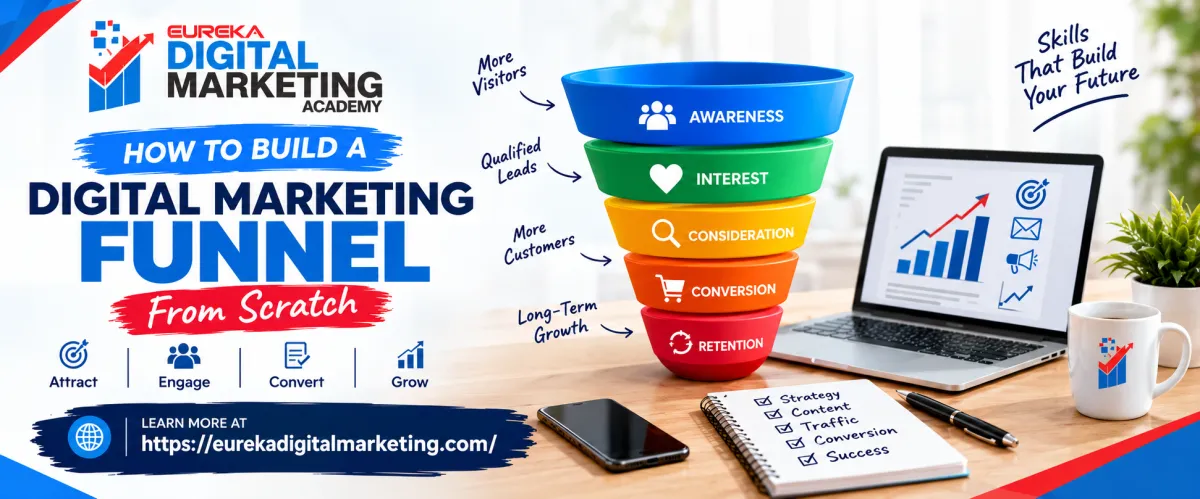
How to Build a Digital Marketing Funnel From Scratch
A digital marketing funnel gives businesses a structured way to move people from their first interaction with a brand toward becoming leads and customers. Instead of sending every visitor directly to a sales page, a funnel creates a journey based on the user's needs, interests, and stage in the buying process.
Learning how to build a digital marketing funnel from scratch can help businesses organize their marketing activities, capture qualified leads, nurture prospects, and improve conversions.
Whether you are a small business owner, freelancer, startup, or digital marketer, you can build a marketing funnel by following a clear step-by-step process.
What Is a Digital Marketing Funnel?
A digital marketing funnel is a framework that represents the stages a potential customer moves through before taking a desired action.
A typical funnel can include:
Awareness
Interest
Consideration
Conversion
Retention
Each stage has a different purpose. Someone who has never heard about your business may need educational content, while someone who is already comparing solutions may need a strong offer, proof, or a clear call to action.
Before building your own funnel, it helps to understand the fundamentals of what a funnel is and the different types of funnels.
The goal is not simply to create several pages and connect them together. A successful funnel should guide the right audience toward the next logical step.
How to Build a Digital Marketing Funnel Step by Step
Building a funnel from scratch becomes easier when you divide the process into individual stages.
1. Define Your Marketing Goal
Start by deciding what you want the funnel to achieve.
Your goal could be to:
Generate leads
Book consultations
Sell a product
Promote a service
Get course registrations
Collect email subscribers
Generate demo requests
Encourage purchases
A clear goal helps you decide what pages, content, offers, and calls to action your funnel needs.
For example, a service business may want visitors to complete a consultation form, while an ecommerce business may want visitors to purchase a product.
Avoid trying to achieve several unrelated goals with one funnel. A focused funnel usually creates a clearer customer journey.
2. Identify Your Target Audience
The next step is understanding who you want to attract.
Create a basic buyer persona by considering:
Age and location
Industry or occupation
Problems and challenges
Goals
Interests
Purchasing behavior
Budget
Common objections
Preferred communication channels
Your target audience influences almost every part of your funnel, including your messaging, content, offer, landing page, advertising, and follow-up process.
For example, a funnel targeting beginners may need educational content that explains a problem from the basics. A funnel targeting experienced business owners may focus more on results, pricing, efficiency, and return on investment.
3. Understand the Customer Journey
Once you know your audience, think about the journey they need to take before becoming a customer.
Ask questions such as:
How will they discover the business?
What problem are they trying to solve?
What information do they need?
What objections might prevent them from taking action?
What would make them trust the business?
What action should they take next?
This helps you connect each funnel stage to a specific customer need.
For example:
Awareness → Educational content
Interest → Valuable resource
Consideration → Offer and proof
Conversion → Strong call to action
Retention → Follow-up and customer support
The funnel should feel like a natural progression rather than a series of disconnected marketing messages.
4. Choose Your Traffic Sources
A funnel needs visitors, so decide where your audience will come from.
Potential traffic sources include:
Google Search
SEO
Google Ads
Facebook Ads
Instagram
YouTube
Email marketing
Content marketing
Referral traffic
Social media
Different traffic sources can attract people with different levels of buying intent.
For example, someone searching for a specific service on Google may already have a strong need, while someone discovering educational content through social media may still be learning about the problem.
Your traffic source should therefore match your funnel message and landing page.
5. Create Content for the Awareness Stage
At the top of the funnel, people may not be ready to buy.
They may simply be looking for information or trying to understand a problem.
Create useful content that answers their questions.
Examples include:
Blog posts
Educational videos
Guides
Checklists
Social media posts
Tutorials
Infographics
Free resources
The objective at this stage is to attract relevant visitors and establish initial trust.
A broader digital marketing lead-generation strategy can also help you connect traffic generation, valuable content, landing pages, offers, and follow-up into one process.
6. Create a Lead Magnet or Valuable Offer
Once visitors are interested, give them a reason to take the next step.
A lead magnet is a useful resource offered in exchange for contact information.
Examples include:
Free ebook
Checklist
Template
Free consultation
Webinar
Guide
Free audit
Educational resource
Discount
Demo
The lead magnet should solve a small but meaningful problem for your target audience.
For example, a digital marketing business could offer a free website SEO checklist to people who want to improve their online visibility.
The offer should also connect naturally with the product or service you eventually want to sell.
7. Build a Dedicated Landing Page
Your landing page is one of the most important parts of many digital marketing funnels.
Instead of sending every visitor to your homepage, create a page specifically designed around the funnel's objective.
A strong landing page can include:
Clear headline
Value proposition
Benefits
Relevant visuals
Supporting information
Trust signals
Testimonials
Lead form
Strong call to action
If you are unsure about the role of a landing page within a funnel, see this guide on Landing Page vs Website. A landing page is generally designed around a specific action, while a website serves broader informational and branding purposes.
The key is to remove unnecessary distractions and make the desired action obvious.
8. Create a Clear Call to Action
Every important funnel stage should have a clear next step.
Your CTA might say:
Get Started
Download the Guide
Book a Consultation
Request a Quote
Register Now
Start Your Free Trial
Contact Us
Enroll Now
The CTA should match the user's stage in the funnel.
Someone who has just discovered your business may not be ready for a high-commitment purchase. A lower-friction action such as downloading a guide or requesting more information may be more appropriate.
As prospects move further down the funnel, the CTA can become more focused on conversion.
9. Capture and Qualify Leads
When a visitor submits a form, your funnel should capture the lead and organize the information you need.
Depending on the business, you may collect:
Name
Email address
Phone number
Company
Business type
Service requirement
Budget
Preferred contact method
Do not ask for unnecessary information. A complicated form can create friction and reduce completion rates.
For higher-value services, you can use additional questions to help determine whether a lead is a good fit.
10. Nurture Leads With Follow-Up
Not every lead is ready to purchase immediately.
This is where lead nurturing becomes important.
A follow-up sequence can include:
Welcome email
Educational content
Case studies
Testimonials
Helpful resources
Product or service information
Frequently asked questions
Special offers
Consultation invitations
Email marketing can be particularly useful for staying connected with prospects after they enter the funnel. You can learn more about using email marketing to generate more leads and incorporate email into your broader funnel strategy.
The purpose of nurturing is not to repeatedly pressure people to buy. Instead, provide relevant information that helps them move toward an informed decision.
11. Build the Conversion Stage
The conversion stage is where a qualified prospect takes your main desired action.
Depending on your business, this could mean:
Purchasing a product
Booking a consultation
Enrolling in a course
Requesting a quote
Signing a contract
Starting a subscription
Booking a demo
At this point, your funnel should clearly communicate:
What are you offering?
Who is it for?
What problem does it solve?
What benefits does it provide?
Why should the prospect trust you?
What should they do next?
Strong value propositions, relevant proof, transparent information, and a simple conversion process can reduce unnecessary friction.
12. Optimize Your Funnel for Conversions
Building the funnel is only the beginning.
After launching it, identify where visitors are dropping out.
For example:
1,000 visitors → 300 landing-page interactions → 100 leads → 20 sales
This basic example shows why every stage needs measurement.
If many people visit the landing page but very few submit the form, you may need to improve the headline, offer, CTA, page structure, form, or trust signals.
This is where Conversion Rate Optimization (CRO) becomes important.
CRO focuses on improving pages and marketing experiences so that more visitors complete the desired action.
You can test:
Headlines
CTA wording
Forms
Offers
Page layouts
Images
Trust signals
Content
Button placement
Avoid changing everything at once. Test individual elements where possible so you can better understand what influences performance.
13. Track Your Funnel Performance
You cannot effectively improve a funnel if you do not know how it is performing.
Track metrics such as:
Website traffic
Landing page visits
Click-through rate
Lead conversion rate
Number of leads
Cost per lead
Sales conversion rate
Customer acquisition cost
Cost per conversion
Revenue
Return on investment
For example, a funnel may generate thousands of visitors but very few leads. Another may generate fewer visitors but produce highly qualified prospects.
This is why traffic alone should not be treated as the main measure of funnel success.
For a deeper understanding, see how conversion tracking for digital campaigns helps improve marketing ROI.
Conversion tracking can help connect marketing activities with actions such as form submissions, purchases, bookings, and other business outcomes.
14. Retarget Visitors Who Did Not Convert
Many people will leave your funnel without converting on their first visit.
Retargeting can help you reconnect with some of these visitors through advertising or other follow-up channels.
For example, someone might:
Visit your landing page.
Read the offer.
Leave without submitting the form.
See a relevant follow-up advertisement later.
Return to the website.
Complete the desired action.
The exact retargeting strategy depends on the business, audience, platform, privacy requirements, and campaign objective.
15. Improve the Funnel Based on Data
A funnel should not remain unchanged after launch.
Review your data regularly and identify:
Where visitors leave
Which traffic sources produce leads
Which pages convert
Which offers attract attention
Which CTAs receive engagement
Which leads become customers
Where acquisition costs are increasing
Which stages create unnecessary friction
Then make targeted improvements.
This creates a continuous cycle:
Build → Launch → Measure → Test → Optimize → Repeat
Over time, data-driven improvements can make the customer journey more efficient.
Common Digital Marketing Funnel Mistakes
Sending All Traffic to the Homepage
A homepage often contains many navigation options and different messages. A campaign-specific landing page can provide a more focused experience.
Building a Funnel Without Understanding the Audience
A funnel should be based on customer needs, problems, objections, and buying behavior.
Using the Same Message at Every Stage
Someone discovering your brand for the first time does not necessarily need the same message as someone ready to purchase.
Using Weak Calls to Action
Visitors should understand exactly what action they can take next.
Asking for Too Much Information
Long forms can create unnecessary friction. Ask only for information that supports the next stage of your process.
Ignoring Mobile Users
Your pages, forms, buttons, and checkout or booking process should work properly on mobile devices.
Not Tracking Conversions
Without conversion data, it becomes difficult to identify which parts of the funnel are producing actual business results.
Focusing Only on Traffic
More traffic does not automatically mean more customers. The quality of traffic and performance of each funnel stage also matter.
Simple Digital Marketing Funnel Example
Imagine a digital marketing academy wants to generate leads for its training program.
The funnel could look like this:
Step 1 — Traffic
Potential students discover the academy through Google Search, social media, or educational content.
Step 2 — Awareness
They read an article about digital marketing careers or skills.
Step 3 — Lead Magnet
They download a free digital marketing checklist.
Step 4 — Lead Capture
They provide their name and email address.
Step 5 — Nurturing
They receive educational emails, course information, student results, and useful resources.
Step 6 — Consideration
They explore the course curriculum, trainer information, benefits, and FAQs.
Step 7 — Conversion
They contact the academy or enroll in the course.
Step 8 — Measurement
The academy tracks traffic, leads, conversion rates, and enrollments to understand how the funnel performs.
This example shows that a digital marketing funnel is not simply a sales page. It is a connected customer journey that combines traffic, content, landing pages, lead capture, nurturing, conversion, and measurement.
Final Thoughts
Learning how to build a digital marketing funnel from scratch starts with understanding your audience and defining a clear business goal.
From there, you can map the customer journey, choose traffic sources, create useful content, develop a valuable offer, build a focused landing page, capture and nurture leads, and guide qualified prospects toward conversion.
But the work does not end when the funnel goes live.
The most effective approach is to continuously measure funnel performance, identify drop-off points, test improvements, and optimize the customer journey based on real data.
A well-structured funnel connects different digital marketing activities into one organized process—from the first interaction with a potential customer to the final conversion and beyond.