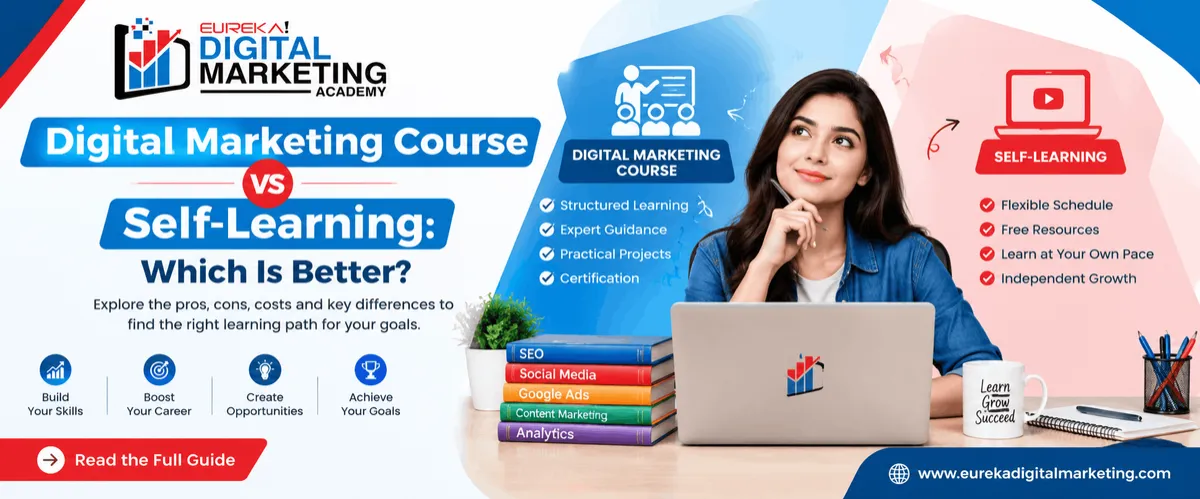
Digital Marketing Course vs Self-Learning: Which Is Better?
Learning digital marketing can open opportunities in freelancing, employment, entrepreneurship, and business growth. However, beginners often face one important question: should they enroll in a digital marketing course or learn digital marketing on their own?
Both approaches have advantages. A structured digital marketing course can provide an organized curriculum, expert guidance, practical assignments, and feedback. Self-learning, on the other hand, offers flexibility, independent study, and access to free online resources.
The right choice depends on your budget, learning style, available time, and career goals. In this guide, we will compare a digital marketing course vs self-learning, explore their costs and benefits, and help you decide which learning path suits your needs.
What Is a Digital Marketing Course?
A digital marketing course is a structured training program that teaches learners how to promote businesses, products, and services through online channels. Depending on the curriculum, it may cover search engine optimization (SEO), social media marketing, paid advertising, content marketing, email marketing, analytics, and marketing automation.
A well-designed course follows a learning sequence, helping beginners understand fundamental concepts before progressing to practical tasks. Learners may also receive assignments, instructor feedback, project experience, and career guidance.
For example, a comprehensive digital marketing certification program can help learners explore multiple marketing disciplines through a more organized learning process.
Key Features of a Digital Marketing Course
Structured curriculum: Learn topics in a logical sequence rather than jumping between unrelated tutorials.
Expert guidance: Ask questions and receive feedback from an instructor.
Practical assignments: Apply concepts through marketing exercises and projects.
Skill development: Build knowledge of SEO, advertising, social media, content, and analytics.
Learning accountability: Follow a schedule and work toward defined milestones.
Career preparation: Develop practical skills that may support job applications or freelance work.
The quality of these benefits depends on the course provider. Before enrolling, check the curriculum, trainer experience, practical components, student support, and assessment methods.
What Is Self-Learning in Digital Marketing?
Self-learning means developing digital marketing skills independently without enrolling in a formal training program. Learners use resources such as YouTube tutorials, blogs, online documentation, free courses, podcasts, and practice projects.
This approach is useful for people who prefer flexible schedules or want to explore digital marketing before spending money on professional training.
For example, a beginner can learn keyword research through free SEO tutorials, practice writing optimized content on a personal website, and analyze traffic using available analytics tools.
Key Features of Self-Learning
Flexible schedule: Study whenever it fits your routine.
Low initial cost: Start with free educational resources.
Independent learning: Choose topics according to your interests and goals.
Practical experimentation: Test strategies through personal projects.
Continuous exploration: Learn new tools and marketing techniques independently.
Self-discipline: Manage your own schedule, progress, and learning priorities.
Self-learning can produce strong results, but it requires consistency, reliable resources, and a plan for gaining practical experience.
Digital Marketing Course vs Self-Learning: Key Differences
Understanding the main differences can help you select the most suitable learning method.
Comparison FactorDigital Marketing CourseSelf-LearningLearning structureOrganized curriculumLearner creates their own planCostUsually requires a feeCan begin with free resourcesFlexibilityDepends on course scheduleUsually highly flexibleInstructor supportAvailable when includedUsually limited or unavailableFeedbackMay include assignments and reviewsRequires self-evaluation or outside feedbackPractical experienceDepends on projects and training qualityRequires independent practiceLearning paceFollows a course structureControlled by the learnerAccountabilityDeadlines and scheduled sessions may helpRequires personal disciplineCertificationMay be offeredUsually no formal certificateCareer preparationMay include portfolio or career supportMust generally be arranged independently
Neither option guarantees professional success. Your results depend on the quality of your learning, the amount of practical work you complete, and your ability to apply digital marketing strategies effectively.
Benefits of Joining a Digital Marketing Course
A digital marketing course can be helpful for beginners who want a clear starting point and guidance while learning unfamiliar concepts.
1. Follow a Structured Learning Path
Digital marketing includes many connected disciplines. Learning SEO, paid advertising, content strategy, social media, and analytics without a plan can become confusing.
A structured course helps learners understand which skills to develop first and how different marketing channels work together. Instead of randomly switching between tutorials, you can progress from foundational concepts to more advanced strategies.
This is particularly useful for people who have never worked on a website, managed an advertising campaign, or analyzed marketing data.
2. Receive Expert Guidance and Feedback
When learning independently, it can be difficult to identify mistakes in your work. For example, you might optimize a page for the wrong search intent or create an advertising campaign without appropriate conversion tracking.
An experienced instructor can help identify these issues, explain alternative approaches, and provide feedback on your work.
However, not every course provides the same level of support. Check whether instructors offer individual feedback, practical demonstrations, and opportunities to ask questions before enrolling.
3. Gain Hands-On Practical Experience
Digital marketing is a practical field. Understanding a concept is different from implementing it successfully.
A good training program should help you practice tasks such as:
Conducting keyword research and creating an SEO plan.
Optimizing website pages for search engines.
Developing a social media content calendar.
Creating and evaluating advertising campaigns.
Writing marketing copy for landing pages and advertisements.
Reviewing website traffic and campaign performance.
Using data to improve marketing decisions.
When evaluating digital marketing training in Karachi, look for practical projects, opportunities to work with marketing tools, and clear explanations of how assignments relate to real business needs.
4. Develop Skills Across Multiple Marketing Channels
Businesses often combine several digital marketing channels to reach their audiences. A course can help you understand how SEO, content marketing, paid advertising, social media, and analytics support a common business objective.
You can also explore specialized training when you want to develop a particular skill. For instance, a Google Ads course in Karachi can be relevant if your goal is to learn paid search advertising and campaign optimization.
Learning these skills in context helps you understand not only how individual tools work but also when to use them.
5. Build Accountability and Learning Consistency
Many beginners start learning digital marketing enthusiastically but struggle to maintain progress. A structured course can provide deadlines, lessons, assignments, and progress milestones.
These elements can make it easier to maintain a consistent routine and finish topics that might otherwise remain incomplete.
Accountability is especially useful if you have difficulty organizing independent study or need guidance to stay focused on your goals.
Benefits of Learning Digital Marketing on Your Own
Self-learning is a practical alternative for people who prefer independent study or want to explore digital marketing before committing to a paid course.
1. Learn Digital Marketing with Free Resources
One of the biggest advantages of self-learning is the ability to begin without paying tuition fees. Free tutorials, blogs, documentation, and educational videos can introduce you to important concepts.
You can start with SEO fundamentals, learn content writing, explore social media marketing, and gradually move toward advertising and analytics.
However, free resources vary in quality and may differ in accuracy or freshness. Prioritize reliable educational material and verify important concepts before applying them to a business.
2. Study at Your Own Pace
Self-learning allows you to spend more time on difficult topics and move quickly through concepts you already understand.
For example, if you find keyword research challenging, you can revisit tutorials and practice until you feel confident. If you already understand social media content planning, you can move on to campaign analysis.
This flexibility makes self-paced learning useful for students, working professionals, business owners, and people balancing other responsibilities.
3. Choose Skills According to Your Goals
You do not always need to learn every digital marketing discipline at once.
A person interested in website visibility might begin with SEO and content optimization. Someone interested in paid advertising might focus on Google Ads, audience targeting, and conversion tracking.
Independent learners can customize their study plans around a particular career direction or business objective.
The challenge is ensuring that your learning remains balanced enough to understand related concepts and avoid major skill gaps.
4. Practice Through Personal Projects
Self-learning becomes more valuable when you apply concepts to real tasks.
You could build a simple website, publish optimized blog posts, create a sample social media campaign, or analyze publicly available marketing data. These exercises help you move beyond passive learning and develop problem-solving skills.
You can also document your progress and use completed projects to create a digital marketing portfolio that demonstrates your practical abilities.
Remember that a portfolio should present your own work honestly. Clearly distinguish practice projects from actual client campaigns.
5. Develop Independent Problem-Solving Skills
Digital marketing platforms and strategies change over time. Independent learning helps you develop the habit of researching unfamiliar problems, reading documentation, testing ideas, and evaluating results.
These skills remain useful even after completing a formal course.
The key is to combine independent research with practical experimentation instead of relying exclusively on watching videos or reading articles.
Digital Marketing Course vs Self-Learning: Which Costs Less?
Cost is an important factor when deciding how to learn digital marketing.
Self-learning can be inexpensive because many introductory resources are available for free. Nevertheless, some learners eventually pay for advanced courses, software, hosting, advertising experiments, or professional feedback.
A digital marketing course requires an upfront investment, but it may provide a curriculum, instruction, assignments, and other learning support within one program.
Consider the following comparison:
ExpenseDigital Marketing CourseSelf-LearningLearning materialsOften included in the course feeFree or paid resourcesInstructor supportDepends on the programMay require paid mentorshipSoftware and toolsMay be included or separateDepends on your chosen projectsPractice projectsMay be providedYou arrange your ownCertificationMay be includedOptional third-party certificationTime investmentDepends on course lengthDepends on your study plan
The cheapest option is not necessarily the best value. Compare what you receive with what you need to achieve your learning goals.
Before choosing a paid program, review the syllabus, total cost, practical training, available support, and refund policy where applicable.
Which Option Helps You Gain Practical Digital Marketing Skills?
Practical experience is one of the most important factors in becoming a capable digital marketer.
A course can provide guided assignments and feedback, but simply attending classes is not enough. Similarly, watching free tutorials does not automatically develop professional skills.
Regardless of your learning method, try to complete projects such as:
SEO project: Research keywords, optimize website pages, and monitor organic performance.
Content marketing project: Plan and publish content for a defined audience.
Social media project: Develop a content calendar and measure engagement.
Paid advertising project: Learn campaign structure, targeting, budgeting, and performance analysis in a suitable practice environment.
Analytics project: Interpret traffic and conversion data and recommend improvements.
Learners interested in paid campaigns can explore a specialized PPC course in Karachi to understand the skills involved in search advertising and campaign management.
Whenever possible, work on a real website or project with clear objectives. Follow platform policies, obtain permission before accessing business accounts, and avoid spending advertising money until you understand the risks and budget controls.
How Long Does It Take to Learn Digital Marketing?
There is no fixed timeline for mastering digital marketing. Your progress depends on your starting knowledge, study hours, chosen specialization, and amount of practical experience.
A reasonable learning roadmap for a beginner might look like this:
Month 1: Understand the Fundamentals
Learn how digital marketing works, identify target audiences, understand the customer journey, and explore SEO, content marketing, social media, and paid advertising.
Month 2: Focus on Core Skills
Choose one or two areas for deeper study. Practice keyword research, website optimization, content planning, advertising fundamentals, or analytics.
Month 3: Complete Practical Projects
Apply your knowledge to a website, content project, sample campaign, or suitable business project. Track results and identify areas for improvement.
Month 4 and Beyond: Improve and Specialize
Refine your work, study more advanced strategies, build a portfolio, and develop a specialization aligned with your career goals.
This is an illustrative plan, not a guarantee of professional readiness. Some learners may progress faster, while others need more time to build confidence and experience.
Can You Become a Digital Marketer Without Taking a Course?
Yes. You can learn digital marketing independently and pursue career or freelance opportunities without completing a formal course.
However, you need a consistent study plan, reliable resources, practical experience, and evidence of your skills.
Start by selecting a specific learning goal. For example, you could focus on SEO, learn the basics, optimize a website, and document your work. Then expand into related skills such as content strategy, analytics, or conversion optimization.
You should also learn how to explain your decisions. Employers and clients may want to know why you selected certain keywords, how you evaluated a campaign, or what you changed to improve performance.
If you are learning independently, use this checklist:
Choose a digital marketing specialization.
Follow a structured learning roadmap.
Study reliable and current resources.
Practice on projects instead of only consuming content.
Track results and document your work.
Ask experienced professionals for feedback when possible.
Keep updating your skills as tools and platforms change.
Independent learning can be effective, but it requires patience and the ability to evaluate your own progress honestly.
How to Choose the Right Digital Marketing Learning Path
Before deciding between a digital marketing course and self-learning, evaluate your current situation.
Choose a Digital Marketing Course If:
You are a complete beginner and need a clear learning structure.
You prefer instructor guidance and feedback.
You want organized practical assignments.
You struggle to maintain a consistent independent study routine.
You value a learning environment with defined milestones.
You have found a course that matches your goals and budget.
Choose Self-Learning If:
You want to explore digital marketing before making a financial commitment.
You are comfortable researching and organizing information independently.
You can maintain a regular study schedule.
You have access to suitable practice projects.
You prefer flexible learning and independent experimentation.
You can evaluate your work and seek feedback when necessary.
Consider a Hybrid Learning Approach
You do not have to choose only one method.
Many learners can benefit from combining structured training with independent study. A course can provide direction and foundational knowledge, while free resources and personal projects help reinforce concepts and explore advanced topics.
For example, you might study SEO through a structured program, practice website optimization independently, and use additional resources to learn technical SEO. This approach combines guidance with flexibility.
Why Practical Training Matters When Choosing a Course
Not all digital marketing courses offer the same value. A course that focuses mainly on theory may leave learners unprepared for practical tasks.
Before enrolling, look for a curriculum that explains how to use digital marketing tools, complete projects, analyze results, and solve common marketing problems.
You should also check whether the program offers:
Clear learning objectives and an updated syllabus.
Relevant instruction in SEO, content, social media, or advertising.
Hands-on assignments and project feedback.
Opportunities to build a portfolio.
Transparent pricing and course details.
Realistic information about career support and certification.
If you are comparing local training options, marketing classes near you in Karachi can be a starting point for reviewing structured learning opportunities.
For a better understanding of how training can relate to career development, you can also explore Eureka Digital Marketing Academy's student success stories. Use testimonials as one source of information, alongside curriculum details, practical work, and your own career requirements.
A certificate may demonstrate that you completed a program, but it does not replace the ability to perform digital marketing tasks effectively.
Final Verdict: Digital Marketing Course vs Self-Learning
The choice between a digital marketing course vs self-learning depends on how you prefer to study, your budget, and the level of guidance you need.
A digital marketing course may suit beginners who want an organized curriculum, instructor feedback, and guided practical exercises. Self-learning may be a better fit for people who prefer flexibility, want to begin with free resources, and can manage their own progress.
Both paths can help you develop valuable skills. Neither guarantees a job, clients, or income without consistent practice and demonstrated ability.
If you are unsure where to start, explore the fundamentals through free resources and identify the skills you want to develop. Then compare your needs with the structure and practical opportunities offered by a course.
Ultimately, the best way to learn digital marketing is the approach that helps you build relevant skills, apply them to real projects, measure your results, and keep improving over time.